Did Labour cut or expand the number of quangos?
"When we were in Government, we reduced the number of quangos by 40 per cent"
Tessa Jowell, Labour MP, BBC Question Time 14/10/2010
"The explosion of unaccountable quangos, public sector 'nonjobs' and costly bureaucracy is an indictment of Labour's reckless approach to spending other people's money."
Conservative Party Manifesto 2010.
Background
Cabinet Office Minister Francis Maude yesterday announced a list of 192 Non-Departmental Public Bodies (NDPBs) — more commonly known as quangos — that are due to be disbanded in what the tabloid press has termed the 'bonfire of the quangos'.
Whilst Labour's Tristan Hunt suggested that the much-anticipated statement amounted to little more than "a clammy Sunday afternoon barbecue", there has been some fierce debate over which party was responsible for fostering the perceived 'quangocracy'.
The claim
The Conservatives General Election manifesto laid the blame squarely at the door of the previous Labour Government, describing an "explosion of unaccountable quangos" on their watch.
However this was a charge denied by Shadow Olympics Minister Tessa Jowell. Speaking on last night's Question Time, she claimed that her Government had actually acted to cut back on the number of NDPBs.
She said: "When we were in Government, we reduced the number of quangos by 40 per cent"
So who should we trust in this case of flat contradiction?
Analysis
The Cabinet Office publishes an annual report — Public Bodies — which accounts for the number of NDPBs supported by Government in the preceding year.
This data does seem to lend support to Tessa Jowell's argument. In the 1997 report, 1,128 quangos were counted, which had shrunk to 679 by 2010; a reduction of 39.8 per cent. (The 2010 report has yet to be published online by the Cabinet Office, however Francis Maude made use of the figure in his statement to the House of Commons yesterday).
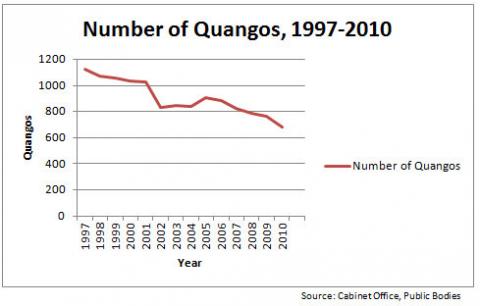 However a closer read of the Cabinet Office reports throws up a complication: the 2009 report states unequivocally that "since 1997, the total number of NDPBs has fallen by 91 — over 10 per cent". This obviously represents a much smaller reduction than that sketched by Ms Jowell; what can account for this?
The answer lies in the small print. Eagle-eyed readers may have noticed a larger than normal drop in the number of quangos appearing in the 2002 survey. This is no accident: before 2002, the Cabinet Office counted NDPBs attached to each of the devolved assemblies, which after 2002 were no longer included in the figures.
A like-for-like comparison, whilst still showing a decline in the number of quangos maintained under the last Government, does not show a cut quite as drastic as 40 per cent.
The Conservatives are nearer the mark with their accusation that the associated costs of running the 'bureaucracy' increased under Labour. In 1997 the NDPB bill paid by Government was £18.6 billion, whereas in 2009 it had reached £38.4 billion.
This represents a nominal increase of 106 per cent, or a real terms cash injection of £14.1 billion. It is worth bearing in mind, however, that these costs had been increasing before Labour took power in 1997, and the equivalent increase in the 13 years between 1984 and 1997 was more than double that which was seen under Tony Blair and Gordon Brown's premierships.
Conclusion
Whilst Tessa Jowell is nearer the mark with her claim that her Government reduced the number of quangos whilst in office, a like-for-like analysis of the figures shows a fall less than half as large as the one she describes.
However a closer read of the Cabinet Office reports throws up a complication: the 2009 report states unequivocally that "since 1997, the total number of NDPBs has fallen by 91 — over 10 per cent". This obviously represents a much smaller reduction than that sketched by Ms Jowell; what can account for this?
The answer lies in the small print. Eagle-eyed readers may have noticed a larger than normal drop in the number of quangos appearing in the 2002 survey. This is no accident: before 2002, the Cabinet Office counted NDPBs attached to each of the devolved assemblies, which after 2002 were no longer included in the figures.
A like-for-like comparison, whilst still showing a decline in the number of quangos maintained under the last Government, does not show a cut quite as drastic as 40 per cent.
The Conservatives are nearer the mark with their accusation that the associated costs of running the 'bureaucracy' increased under Labour. In 1997 the NDPB bill paid by Government was £18.6 billion, whereas in 2009 it had reached £38.4 billion.
This represents a nominal increase of 106 per cent, or a real terms cash injection of £14.1 billion. It is worth bearing in mind, however, that these costs had been increasing before Labour took power in 1997, and the equivalent increase in the 13 years between 1984 and 1997 was more than double that which was seen under Tony Blair and Gordon Brown's premierships.
Conclusion
Whilst Tessa Jowell is nearer the mark with her claim that her Government reduced the number of quangos whilst in office, a like-for-like analysis of the figures shows a fall less than half as large as the one she describes.
However a closer read of the Cabinet Office reports throws up a complication: the 2009 report states unequivocally that "since 1997, the total number of NDPBs has fallen by 91 — over 10 per cent". This obviously represents a much smaller reduction than that sketched by Ms Jowell; what can account for this?
The answer lies in the small print. Eagle-eyed readers may have noticed a larger than normal drop in the number of quangos appearing in the 2002 survey. This is no accident: before 2002, the Cabinet Office counted NDPBs attached to each of the devolved assemblies, which after 2002 were no longer included in the figures.
A like-for-like comparison, whilst still showing a decline in the number of quangos maintained under the last Government, does not show a cut quite as drastic as 40 per cent.
The Conservatives are nearer the mark with their accusation that the associated costs of running the 'bureaucracy' increased under Labour. In 1997 the NDPB bill paid by Government was £18.6 billion, whereas in 2009 it had reached £38.4 billion.
This represents a nominal increase of 106 per cent, or a real terms cash injection of £14.1 billion. It is worth bearing in mind, however, that these costs had been increasing before Labour took power in 1997, and the equivalent increase in the 13 years between 1984 and 1997 was more than double that which was seen under Tony Blair and Gordon Brown's premierships.
Conclusion
Whilst Tessa Jowell is nearer the mark with her claim that her Government reduced the number of quangos whilst in office, a like-for-like analysis of the figures shows a fall less than half as large as the one she describes.
The Conservative claim that the quantity of NDPBs 'exploded' under Labour is categorically false, however the costs associated with their running did rise in this period, albeit by less than they did under Thatcher and Major.
Was this helpful?
Full Fact fights for good, reliable information in the media, online, and in politics.