Viral posts falsely claim judicial review on state pension age change set for June

What was claimed
A campaign group has won the right to a judicial review next June and will challenge the Department for Work and Pensions over the change in state pension age from 65 to 67.
Our verdict
This is false. The Department for Work and Pensions told Full Fact there is no such judicial review and the posts appear to be resharing old information about a 2019 High Court date on changes to the state pension age.
Thousands of Facebook users have shared a viral post claiming that a judicial review is taking place in June which could force the government to lower the state pension age back to 65.
But the information it contains is old—it appears to refer to a case that happened back in 2019. The Department for Work and Pensions (DWP) has confirmed to Full Fact that no such judicial review is set to take place.
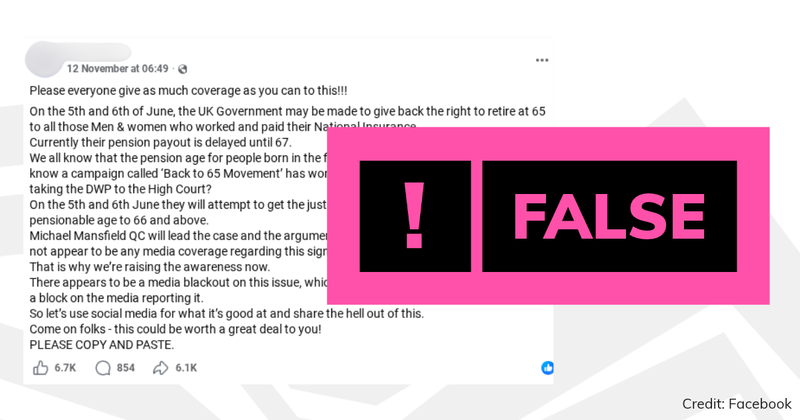
The post, which has been copied and pasted by dozens of Facebook users in recent weeks, claims that the “Back to 65 Movement” has won the right to a judicial review and will take the DWP to the High Court in June in an “attempt to get the justice over the non consultation in raising the pensionable age to 66 and above”.
The state pension age is currently being increased from 66 to 67, having increased from 65 to 66 between 2018 and 2020.
Join 75,000 newsletter subscribers who trust us to check the facts
Sign up to get weekly updates on politics, immigration, health and more.
Subscribe to weekly email newsletters from Full Fact for updates on politics, immigration, health and more. Our fact checks are free to read but not to produce, so you will also get occasional emails about fundraising and other ways you can help. You can unsubscribe at any time. For more information about how we use your data see our Privacy Policy.
The post also states that “there appears to be a media blackout on this issue, which suggests that the government have put a block on the media reporting it”.
However, this post appears to be resharing old information about a 2019 High Court date for a judicial review brought by the Backto60 campaign, which argued that the increased state pension age for women from 60 to 65 was discrimination.
The judicial review (a court case where someone challenges the lawfulness of a government or government body’s decision) went to the High Court on 5 June 2019 and was lost by campaigners. This judgement was handed down in October 2019.
Campaigners were denied leave to appeal by the Supreme Court in 2021.
Similarities between the recent social media posts and the 2019 judicial review include the date of the apparent High Court hearings, which are both listed as 5 June.
The posts also claim that “Michael Mansfield QC will lead the case and the argument for the movement”. It is true that Mr Mansfield represented the Backto60 campaigners at the High Court and the Court of Appeal years ago.
However, his chambers confirmed to Full Fact that his last involvement with the Backto60 campaign ended in 2020.
Another indication the posts are old is that senior barristers are now appointed as King’s Counsel (KC) as opposed to Queen’s Counsel (QC) following the death of Queen Elizabeth II in 2022.
The Women Against State Pension Inequality (WASPI) campaign, which campaigns on what it says was a lack of notice given to women affected by the state pension age increases, has previously warned of old information about the 2019 judicial review being shared online as if it was current.
A spokesperson told us that the recent posts are “all based on out of date information that regrettably resurfaces from time to time, referencing a historic legal case”.
A petition to reduce the state pension age to 65 has reached over 100,000 signatures and will be considered for debate in Parliament. However, this is not the same as a judicial review. The government issued a response to the petition in October saying it has no plans to lower the state pension age.
Before sharing information you see on social media it’s important to consider whether it comes from a trusted and verifiable source. Our toolkit can give you tips on how to navigate content online.
This article is part of our work fact checking potentially false pictures, videos and stories on Facebook. You can read more about this—and find out how to report Facebook content—here. For the purposes of that scheme, we’ve rated this claim as false because the Department for Work and Pensions told Full Fact there is no such judicial review on the state pension age changing to 67 and this appears to be referring to a High Court hearing in June 2019.
Was this helpful?
Full Fact fights for good, reliable information in the media, online, and in politics.