Budget 2025: fact checked
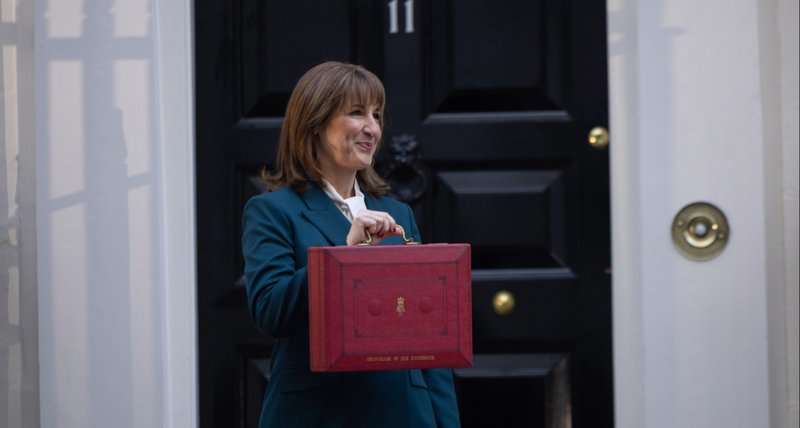
On Wednesday the Chancellor of the Exchequer, Rachel Reeves, delivered the second Budget of this Labour government.
We’ve been fact checking a series of claims made by the chancellor in her speech, and by the Conservative leader Kemi Badenoch in her Budget response. (This year we’ve also partnered with the Independent to cover the Budget, so you may also see some of our analysis on its website.)
Here are some of the key announcements and claims we’ve examined.
Join 73,000 newsletter subscribers who trust us to check the facts
Sign up to get weekly updates on politics, immigration, health and more.
Subscribe to weekly email newsletters from Full Fact for updates on politics, immigration, health and more. Our fact checks are free to read but not to produce, so you will also get occasional emails about fundraising and other ways you can help. You can unsubscribe at any time. For more information about how we use your data see our Privacy Policy.
Has the chancellor kept ‘every single one’ of Labour’s manifesto commitments?
The government’s decision to extend the freeze on income tax and National Insurance thresholds by three years has led many to accuse Labour of breaking its manifesto pledges on tax.
Labour’s 2024 election manifesto said: “Labour will not increase taxes on working people, which is why we will not increase National Insurance, the basic, higher, or additional rates of Income Tax, or VAT.”
Freezing personal tax thresholds means people pay more tax than they would if thresholds rose with inflation.
At last year’s Budget, the chancellor herself appeared to say that extending threshold freezes would break the manifesto pledge for this reason, saying at the time: “I am keeping every single promise on tax that I made in our manifesto, so there will be no extension of the freeze in income tax and national insurance thresholds.”
Yet despite this, at the end of her 2025 Budget speech, Ms Reeves claimed to have kept “every single one” of Labour’s manifesto commitments.
The government now appears to be arguing that Labour’s manifesto commitments apply only to the rates of income tax and National Insurance contributions, and that therefore the extension of the threshold freezes doesn’t break its pledge.
Speaking to Sky News following the Budget, Ms Reeves said “in the manifesto we were very clear it was the rates of income tax and National Insurance and VAT”, though she also acknowledged that the freeze extension was “asking ordinary people to pay a little bit more”.
The wording in Labour’s manifesto about not increasing income tax is clear that it applies to “rates”, for “working people” at least, and it doesn’t explicitly mention the thresholds at which income tax rates apply.
But its commitment on National Insurance is less specific, and the wording doesn’t appear to clearly relate only to rates. And as a result the Institute for Fiscal Studies has said it believes the Budget does breach Labour’s manifesto tax promise.
We’ve looked into this in more detail in a separate fact check.
Lifting of the two-child benefit cap
One of the biggest changes announced in the Budget was that the two-child benefit limit is to be scrapped in full from April 2026.
It comes after senior Labour figures, including education secretary Bridget Phillipson MP and deputy leader Lucy Powell MP, called for an end to the limit, which prevents most families from claiming means-tested benefits for a third and any additional children born after April 2017.
We’ve written before about the likely impact of this change. Government data published in July 2025 estimated that 453,600 households were not receiving the child element of Universal Credit for at least one child because of the policy. The report found there were more than 1.6 million children living in these households.
A number of experts, including those from the Resolution Foundation and Institute for Fiscal Studies, have said that removing the limit would be the most “cost-effective” way to reduce child poverty.
The Child Poverty Action Group has estimated scrapping the policy would lift 350,000 children out of relative poverty “instantly” and stop a further 150,000 children being drawn into poverty by 2029/30.
According to the Office for Budget Responsibility (OBR) forecast published on Wednesday, scrapping the policy will increase Universal Credit payments for an estimated 560,000 families by an average of £5,310 per year by 2029/30.
How many more NHS appointments has the government delivered?
Ms Reeves claimed in her speech that the government has delivered 5.2 million extra NHS appointments since the general election.
As we explain in our Government Tracker, it’s true that there were 5.2 million additional NHS appointments in England between July 2024 and June 2025 compared with the year before (once the data’s been adjusted to standardise the number of working days). But that doesn’t tell the full story.
Historic NHS data, which Full Fact at first had to obtain with a Freedom of Information request, and which has now been published as an official statistic, shows that by recent standards, 5.2 million extra appointments in a year isn’t a particularly large rise. The equivalent figure the year before, under the Conservatives, was 6.5 million.
The number of NHS appointments has been rising for a long time, as it has to, to meet the health needs of a growing and ageing population.
How much have waiting lists fallen by?
The chancellor also said that the NHS waiting list has come down by 230,000 since the current Labour government began.
In simple terms, that’s true—she was referring to the elective treatment waiting list in England (also known as “referral to treatment” or RTT), which is usually what UK politicians mean when they talk about “the waiting list”.
In context, however, the fall has been relatively slight—from about 7.62 million cases in July 2024, to about 7.39 million in September 2025.
Whenever people talk about waiting lists, it’s always worth remembering that waiting times are probably more important, because how long you wait is actually what matters from a patient’s point of view.
In this respect, progress has been more pronounced. Median waiting times for those still on the waiting list (which is one way to measure them) have fallen since July 2024 and are now shorter than they were in 2022.
Is unemployment up ‘every single month’ under Labour?
Responding to the chancellor’s Budget speech, the Conservative leader Kemi Badenoch MP claimed unemployment “is up every single month since Labour have been in office”, adding to MPs, “they don’t want to hear it but it’s true”.
She’s made this claim several times before, and we’ve also heard it from other Conservative MPs. But it’s not quite correct—while it’s true that unemployment has increased under Labour, it hasn’t gone up “every single month”.
Figures from the Office for National Statistics estimate that the number of unemployed people increased by approximately 309,000 between May-July 2024, around the time Labour came to office, and July-September 2025, the most recent period for which figures are available.
But they also show a number of small month-to-month decreases in the number of people unemployed during Labour’s time in government.
Similarly, while the rate of unemployment has increased overall since Labour entered government, there are certain months during which the unemployment rate remained the same when rounded to one decimal place (as the headline figures are published), and the unrounded figures suggest that there were actually some small decreases (though unrounded figures are typically subject to more uncertainty).
It’s worth noting this data all comes from the Labour Force Survey. The ONS has warned estimates from the survey should be treated with caution due to lower than usual response rates since the pandemic.
Is the government ‘miles behind’ on house building?
Mrs Badenoch also mentioned the government’s house building target in her Budget response and said it was “miles behind” its construction plans. Labour pledged to build 1.5 million homes in England by the end of this parliament.
Progress against this is being measured using figures for ‘net additional dwellings’, which measure the change in overall housing stock. This includes new builds, conversions, demolitions and changes of use.
We have official net additional dwellings data for the financial year 2024/25, which covers the last few months of the Conservative government as well roughly the first nine months of Labour’s time in office. These figures show a net 208,600 homes were added to England’s stock that year, down from the 221,410 homes that were added in 2023/24.
But this only takes us up to early April 2025, and we don’t know how many of these homes were added while the Conservatives were still in government.
However, estimates from the government using weekly domestic Energy Performance Certificate lodgements (then adjusted for demolitions) give a better idea of what’s been happening specifically in the period since Labour won the election. These show that between 9 July 2024 and 9 November 2025 there were 275,600 net additional dwellings added to England’s stock—around 18.4% of the 1.5 million target.
Based on our calculations this suggests the government will need to pick up the pace if it wants to see that pledge fulfilled. At the current rate it would take nearly six more years, so our Government Tracker is currently rating this promise as “appears off track”.
The UK’s fiscal rules
In the Budget, Ms Reeves announced that going forward the UK’s fiscal rules will only be assessed once a year, at future Budgets (up until now, they’ve also been assessed at the Spring Statement).
The UK’s fiscal rules are rules that the government has imposed on itself since 1997 that constrain decisions on tax and spending. The rules have been changed multiple times by governments, but currently the two main components are:
- that day-to-day spending costs are met by the government’s revenues
- that debt must fall as a share of the economy by the fifth year of any OBR forecast (currently 2029/30).
The UK is forecast to meet both of these rules, according to the latest OBR forecast.
The forecast says the government’s £9.9 billion of fiscal headroom (the amount of financial buffer it set aside in the Autumn Budget 2024 and the Spring Statement 2025 so it could increase spending or reduce taxes without breaking its fiscal rules) is set to increase to £21.7 billion by 2029/30.
The OBR also forecasts that Public Sector Net Financial Liabilities (PSNFL, the measure of debt used by the government in its second rule) will be falling in 2029/30 and so the rule will be met by a margin of £24.4 billion.
Debt is forecast to rise from 83.1% of GDP this year to 83.7% in 2028/29, before falling in the subsequent years. The OBR forecasts it will be 82.2% of GDP in 2030/31.
Was last year’s Budget ‘the biggest tax raid in British history’?
In her Budget response, Mrs Badenoch claimed that last year Ms Reeves “put up taxes by £40 billion, the biggest tax raid in British history”.
It is true that the Autumn 2024 Budget was expected to raise an additional £36 billion a year in taxes, but as we explained at the time whether that counts as a record depends on how you measure it.
The Institute for Fiscal Studies noted last year that measured as a percentage of GDP, Ms Reeves’ first Budget included tax rises that were the second highest “in decades”.
It said at the time the package would see a tax increase equivalent to 1.21% of forecast GDP, while the Spring Budget in 1993 saw a 1.45% rise.
However, the OBR told us last year that in cash terms, the overall forecast tax increase at the 2024 Budget was even higher than in 1993, when the Conservative chancellor Norman Lamont raised taxes by £38.5 billion.
On Wednesday the chancellor unveiled a further £26 billion in tax rises by 2029/30, which the OBR states will bring “the tax take to an all-time high of 38 per cent of GDP in 2030-31”.
Following the latest Budget’s announcements, the IFS said: “If an election were held tomorrow, the overall tax rises announced in this parliament would exceed those announced in any other since at least 1970.”
Are there really one million more people on Universal Credit?
In her response to Ms Reeves’ Budget speech, Mrs Badenoch also said: “There are a million more people claiming Universal Credit than there were at the time of the last budget.”
While narrowly true, this statement doesn’t mean what you might think.
According to the latest provisional data from the Department for Work and Pensions (DWP), there were about 8,277,289 people on Universal Credit in October 2025, compared with about 7,163,713 in October 2024, when Ms Reeves delivered her last budget statement. That is a rise of about 1.1 million.
However, that doesn’t mean that there’s been a surge of 1.1 million extra people claiming benefits, because the DWP is currently in the process of moving recipients of so-called “legacy benefits” to Universal Credit instead.
We don’t have exact data for the number of existing claimants who have begun to receive Universal Credit since the last budget. But we do know that about 983,237 people were sent migration notice letters in the 12 months to September 2025, and that 817,117 of them had claimed UC by the time the data was collected.
The data doesn’t say how many of them were successful in their claims and went on to receive Universal Credit, but a National Audit Office report in February 2024 said that the DWP expected a large proportion of the people it notified to do so.