Five lessons from our fact checking in 2025
Here at Full Fact Towers we’re about to log off, don our Christmas jumpers and start prepping for a well-earned break. And as is traditional at this time of year, we’ve been taking a look back, reflecting on some of the changes our frontline fact checkers have seen in an action-packed 12 months.
Over the course of 2025, we’ve published over 750 fact checks and related pieces of content, covering everything from major political rows and alarming online misinformation to some frankly bizarre blunders (such as when BBC radio bulletins massively overstated Britain’s cocaine consumption).
So, what trends have we observed? What has our team of fact checkers spotted, scouring the media, social media and Hansard for claims each morning? What’s been different in the last year? And what might that tell us about the year to come?
1) 2025 was the year AI turbocharged online misinformation
We’ve been talking about the dangers of deepfakes, AI-generated imagery and other AI-assisted misinformation for a while—but we saw a step change in volume in 2025.
Without attempting to quantify this in any rigorous way, it’s fair to say that anecdotally at least, generative AI has gone from being a novelty in our fact checking to absolutely routine. In November 2024, we suspected AI was involved in four of the fact checks we published—in October this year, it was at least 27, not least because it’s often used in the flood of false claims we’ve seen about personal freedoms.
In 2026… as AI tools become ever more convincing and more widely adopted, and social media users are forced to adapt to feeds full of ‘AI slop’, expect even more of the same.
2) Reform UK vs Labour is becoming a key battleground for political claims
With Reform UK riding high in the polls, it’s perhaps unsurprising that the party has increasingly featured in our political fact checking.
Claims from Reform UK about the number of illegal immigrants or even whether swans have been eaten by migrants have been among our most-read fact checks of the year, but we’ve also fact checked false claims about senior Reform UK politicians. And our most-read fact check of the year was actually on Labour claims about Reform UK—we looked in detail at whether it was right to say Nigel Farage’s party would “scrap the NHS”.
In 2026… it’s likely claims and counter-claims between Reform UK and Labour will reach fever pitch in the run-up to the May 2026 elections in Scotland, Wales and council seats across England.

3) AI tools are increasingly being used to fact check claims - but they can get it very wrong
People are turning to AI tools to access information on the internet, and so it’s unsurprising that they’re using them as fact checking aids too. On X, for example, it’s now very common to see users reply to questionable posts with a quick “@grok is this true?”.
But while AI tools are undoubtedly convenient, and can often give an instant quick sense-check, we’ve seen a number of instances of them giving inaccurate responses. Our investigation in August revealed Google Lens’ AI overviews had shared misleading information about images, in September Grok wrongly claimed a police video of the ‘Unite the Kingdom’ rally was actually from 2020, and in November both Grok and Google Lens’ AI overviews claimed that fake imagery showed the Huntingdon train attack.
In 2026… use of publicly available chatbots and AI tools, including to fact check claims, is only going to become more common. It remains to be seen if they will become more consistently reliable—and if users will become more used to questioning their reliability.
4) When it comes to monitoring the government’s delivery, the small print really matters
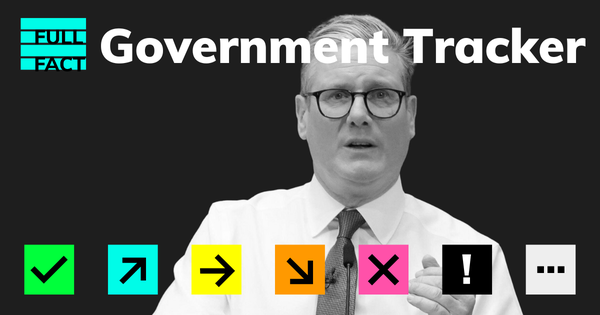
In 2025 we continued to build out our Government Tracker, which is now monitoring the delivery of some 86 Labour pledges. As we wrote back in September, pledge tracking has strengths and limitations when it comes to delivering a verdict on the government’s performance. But one clear strength has been to shine a light on the small print of Labour’s commitments.
For example, our investigation back in May (shared with Sky News) revealed that the rise in the number of hospital appointments celebrated by the government as a “massive increase” was actually smaller than the increase achieved the year before, under the Conservatives. And it was our forensic look at exactly what Labour pledged on tax which enabled us to give a clear verdict on whether November’s Budget broke the party’s manifesto commitments.
In 2026… expect Labour’s commitments to face even greater scrutiny as the government strives to show it is delivering on what it promised.
5) Some ‘zombie’ claims… Just. Won’t. Die.
OK, so it’s not a change, as such. But one of our biggest challenges as fact checkers is tackling persistent false or misleading claims—we sometimes dub these ‘zombie’ claims, because no matter what we do to try and eradicate them, they just keep coming back. And 2025 saw us do battle with many such claims, whether from previous years (false claims about MPs’ breakfast expenses, confusion over the number of people and cases on the NHS waiting list) or new (about unemployment under Labour or deportations and asylum hotels).
We have had some notable successes, particularly when we’ve managed to make the most of Full Fact’s unique combination of capabilities—our fact checking expertise, in-house AI tools and post-publication intervention requests. Indeed, our investigation into whether the UK really has the 12th largest ‘female health gap’ in the world resulted in an almost unprecedented set of corrections, including from the House of Commons and House of Lords libraries, the Scottish government, the Lancet, the BMJ, MPs and many others. But stamping out claims which have become embedded in the public discourse remains an ongoing challenge.
In 2026… tackling persistent claims will continue to be a key part of our work—not least because doing so is a key way we can improve the information served up by Large Language Models.
That, then, is a quick overview of what the last 12 months have looked like for our fact checking team. A merry Christmas and happy New Year from all at Full Fact. Thank you so much for your interest and support for our work—we’ll be gearing up to do much more of the same in 2026.
Join 73,000 newsletter subscribers who trust us to check the facts
Sign up to get weekly updates on politics, immigration, health and more.
Subscribe to weekly email newsletters from Full Fact for updates on politics, immigration, health and more. Our fact checks are free to read but not to produce, so you will also get occasional emails about fundraising and other ways you can help. You can unsubscribe at any time. For more information about how we use your data see our Privacy Policy.