What was claimed
An image shows a human chain in Iran, around a building which appears to be the Bushehr Nuclear Power Plant.
Our verdict
This image isn’t real and was made using artificial intelligence.
What was claimed
An image shows a human chain in Iran, around a building which appears to be the Bushehr Nuclear Power Plant.
Our verdict
This image isn’t real and was made using artificial intelligence.
A fake image of a human chain around a power plant in Iran has been widely shared online.
Although there were reports last week of Iranians surrounding bridges and power plants after President Donald Trump threatened to attack civilian infrastructure, this particular image isn’t real and was made with artificial intelligence (AI).
It includes a distinctive diamond in the bottom right corner, the watermark of Google’s Gemini AI chatbot, and when we ran the image through Google’s SynthID detector, it reported that it contained an invisible SynthID digital watermark which can be used to identify content which has been created or edited with Google’s AI tools.
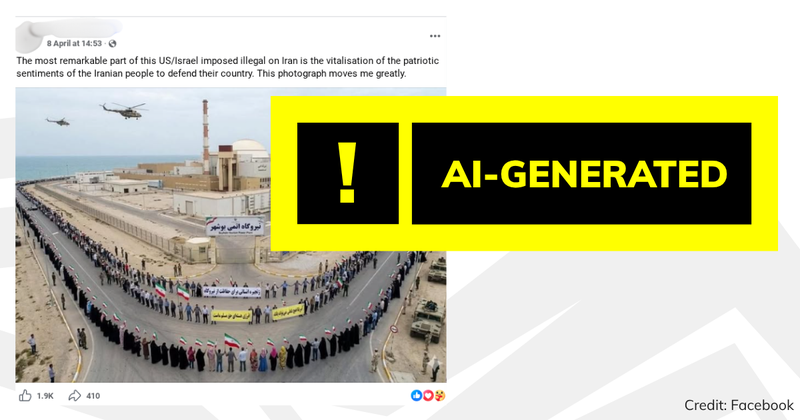
When we ran the image through Google Translate, some of the signs in Persian translated to “Bushehr Nuclear Power Plant” and “human chain to protect power plant”. And we have seen at least one report of people forming a human chain “to support power plants” in Bushehr, though we’ve not been able to independently verify this.
However the viral image does not appear to match real satellite images of the Bushehr Nuclear Power Plant. The chimney is closer to the sea than the dome in the fake image, for example, whereas satellite imagery shows the chimney is actually inland compared to the dome.
Join 73,000 newsletter subscribers who trust us to check the facts
Sign up to get weekly updates on politics, immigration, health and more.
Subscribe to weekly email newsletters from Full Fact for updates on politics, immigration, health and more. Our fact checks are free to read but not to produce, so you will also get occasional emails about fundraising and other ways you can help. You can unsubscribe at any time. For more information about how we use your data see our Privacy Policy.
During breaking news events it’s important to rely on sources that are trustworthy and verifiable when sharing content which you see on social media. Our toolkit and guides on identifying AI-generated content have tips on how to do this.
This article is part of our work fact checking potentially false pictures, videos and stories on Facebook. You can read more about this—and find out how to report Facebook content—here. For the purposes of that scheme, we’ve rated this claim as altered because this image is fake—a watermark indicates it was made with AI.
Full Fact fights for good, reliable information in the media, online, and in politics.
Bad information ruins lives. It promotes hate, damages people’s health, and hurts democracy. You deserve better.
Subscribe to weekly email newsletters from Full Fact for updates on politics, immigration, health and more. Our fact checks are free to read but not to produce, so you will also get occasional emails about fundraising and other ways you can help. You can unsubscribe at any time. For more information about how we use your data see our Privacy Policy.