Why do Reform and the Conservatives both claim they’ve delivered the lowest average council tax increase?
Last month, we wrote about a claim made by Reform UK that it had delivered the lowest average council tax increase of any major party.
After we looked into these figures in detail, our fact check was used to challenge seemingly contradictory figures shared by the Conservative party, which claimed that it, in fact, had implemented the “lowest council tax rises in England”.
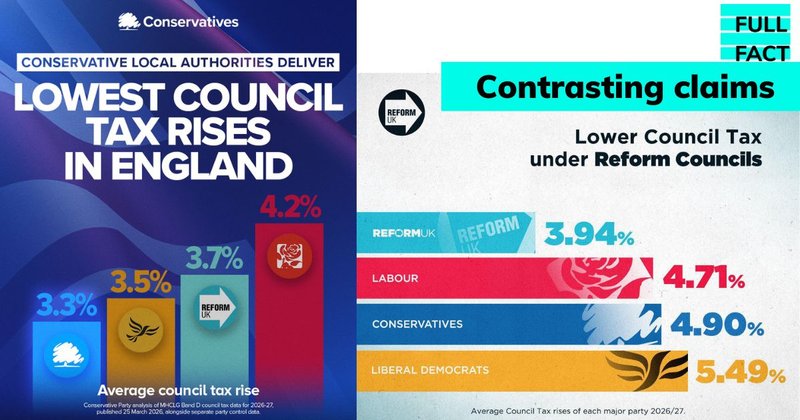
So how have both parties managed to claim they’ve delivered the lowest average council tax increase?
Well, each party has come up with its own set of figures, and they have measured the “average council tax rise” in different ways.
The Conservative party told us that its figures were calculated based on the average Band D council tax percentage increase across all local authorities in England, “where a particular party is in majority control”. By comparison, Reform’s figures only included single-tier councils, and the upper-tier councils in areas with a two-tier system. Local taxes are devolved in Northern Ireland, Scotland and Wales.
Full Fact has broadly, though not precisely, replicated both parties’ figures.
Although neither set of figures is necessarily inaccurate, the Institute for Fiscal Studies (IFS) told us Reform’s figures appeared “more reasonable”. It said the Conservative party’s figures appear to be comparing “apples and pears”, because they include both councils responsible for adult social care services (who are therefore allowed to increase council tax by more each to cover this) and councils that aren’t responsible for this.
Join 75,000 newsletter subscribers who trust us to check the facts
Sign up to get weekly updates on politics, immigration, health and more.
Subscribe to weekly email newsletters from Full Fact for updates on politics, immigration, health and more. Our fact checks are free to read but not to produce, so you will also get occasional emails about fundraising and other ways you can help. You can unsubscribe at any time. For more information about how we use your data see our Privacy Policy.
Why do the Conservatives’ figures differ from Reform’s?
Many parts of the country operate under a “two-tier” council system, meaning some services are provided by smaller district, borough or city councils, while others are provided by larger county councils which cover several of these smaller councils. Other parts of the country have only one tier of local government which provides all local services (unitary authorities, London boroughs and Metropolitan boroughs).
Reform UK’s figures include only upper tier councils (that is, all single tier councils, as well as county councils), whereas the Conservative party’s figures also include district councils.
The different figures in the two parties’ graphics seem to be due to the fact that district councils are not responsible for adult social care services, and therefore do not charge the adult social care precept (the element of the bill which goes towards paying for social care in the area).
As such, district councils can only increase council tax by a maximum of 2.99% without holding a referendum, whereas other councils which do charge the adult social care element can increase it by a maximum of 4.99%. Including district councils in any calculation about the average council tax increase therefore lowers the final figure—particularly for the Conservatives and the Liberal Democrats.
At the time of writing, Reform does not control any district councils, so its average remains the same whether district councils are included or not.
The slight difference in the figure the Conservatives have given for Reform UK and the figure Reform UK produced in its own calculations may be because Reform UK chose not to include Doncaster Council—where they have a majority but do not technically control the council due to its directly elected mayor—as a Reform controlled council, whereas the Conservatives may have done so. It’s worth noting that there is no centralised public government data on council control. Different sources may assign councils differently, and parties may also hold their own internal data.
Which is better?
The Institute for Fiscal Studies told us that the Conservatives’ approach is “essentially comparing apples and pears”, as parties (like the Conservatives) which control more district councils will have lower averages than parties (like Labour) which control more single-tier local authorities.
It added: “A better approach would be to calculate separately the increase for districts (given their 3% limits) excluding parish precepts and the counties and unitaries (with their 5% limits), and then compare apples with apples, and pears with pears.”
The think tank’s Head of Devolved and Local Government Finance David Phillips told Full Fact that Reform’s figures appeared “more reasonable”, but noted that Reform-led councils “did generally get funding boosts from the Fair Funding Review” (which changed the way funding was distributed across councils this year) which may have made it easier for them to keep council tax rises lower than the maximum.
A Reform UK spokesperson said: “Comparing upper tier authorities which face greater financial pressures and a higher council tax cap with lower tiers is entirely misleading. Any honest analysis of average council tax rises over the past year always finds the same thing: Reform-led councils have delivered the lowest average rises of any political party.”
The Conservative party responded to our initial questions about their methodology, but did not respond to our follow-up questions.
Was this helpful?
Full Fact fights for good, reliable information in the media, online, and in politics.