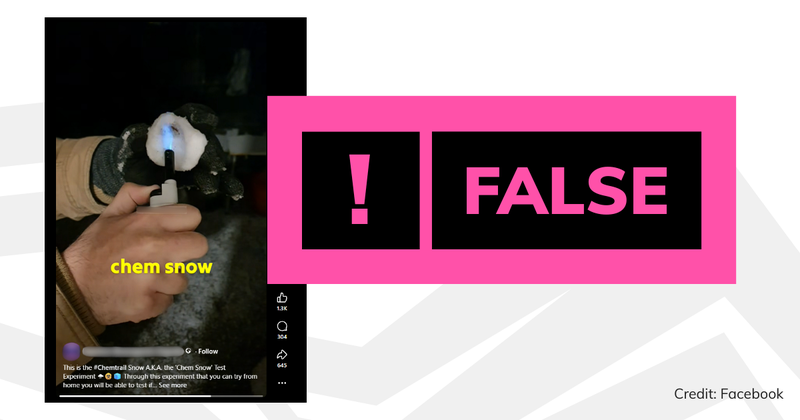
Widely shared claims that holding a flame to snow can test if it’s natural or “chem snow” are false and misunderstand normal chemical processes, experts have told Full Fact.
Videos in which snow appears to go black and doesn’t melt when exposed to a flame have been circulating on X, Instagram and TikTok with some versions gaining millions of views.
One clip filmed in the UK, viewed over 93,000 times, depicts a person holding the flame from a safety gas lighter to a snowball, which begins to blacken and disappear. A person speaking in the footage says: “This is not natural snow, this, this is chem snow.”
A caption with the video adds: “Usually what happens is the Snow when lit with a flame of any kind will start to turn black and smell like burning plastic.
“It will also start to shrink back like Polystyrene that has been lit, it will very rarely drip with water like regular Snow/Ice should do and it will just shrink back into itself.”
The poster warns that children shouldn’t be allowed to “play with this sort of Snow, it's laced full of Toxic Chemtrails that can get them sick”.
But Full Fact has spoken to multiple experts on snow and atmospheric science who confirmed that the claims are based on a misunderstanding of the science of applying heat to snow.
What is actually happening when the snow turns black?
While many of the videos appear to show snow turning black, experts say the marks come from the fuel of the lighter itself (generally butane) rather than the snow turning into something else.
“Full combustion needs a good oxygen supply,” said Professor Elizabeth Morris, a glaciologist at the University of Cambridge.
“If you hold a flame next to a cold piece of snow incomplete combustion will mean that soot is produced and deposited on the snow. The soot comes from the hydrocarbon in the lighter fuel, not from the snow.”
Rachel James, a post-doctoral researcher in atmospheric science at the University of Manchester compared it to how candles sometimes leave soot marks as a result of incomplete combustion.
Alastair Lewis, professor of atmospheric chemistry at the University of York and the National Centre for Atmospheric Science also told Full Fact: “The black residues are very likely smoke particles from the butane flame, plus probably some amount of unburned fuel from the lighter depositing and then oxidising in the flame.”
Why doesn’t the snow appear to melt?
A key part of what is presented as evidence in the video that snow has been tampered with, is that it doesn’t seem to melt when exposed to heat, instead shrinking back in a way described as being like burning polystyrene.
But experts explained to us that normal chemical processes caused this effect, notably sublimation—when a substance changes from a solid to a gas without becoming a liquid in between.
Paul Connolly, professor of atmospheric physics at the University of Manchester said some snow may initially melt in response to the heat, but then get re-absorbed into the rest of the snowball.
“Snow is porous,” he added. “So either some of that water can be sort of soaked into the snow and it will refreeze inside that sort of porous matrix; or it's only a very thin layer at a time that's forming of water, liquid water that'll just heat up to above 100°C very quickly with that kind of flame, and sublime straight to water vapour.”
Professor Morris also told us the snowball could be subliming invisibly from solid to gas or the water was being absorbed into the pores between the remaining grains of snow.
“I suspect the meltwater from the hole in the snowball being produced by the flame is being sucked up into the surrounding snow rather than dripping down as the experimenter expects,” she said.
Professor Lewis also offered a similar analysis about what can be observed in the video “An individual snowflake doesn’t have very much water in it, so when it melts the liquid can be adsorbed onto the surfaces of other flakes, ultimately becoming more like a wet ice droplet,” he told Full Fact.
“That uptake might mean that liquid water doesn’t necessarily immediately fall from the snowball. It's similar to how snow depth shrinks as fresh snow warms slightly and goes from being fluffy ice crystals to wet ice droplets.”
Other claims that snow is ‘fake’
Other claims that the formation of recent snowfall is “fake” or chemically altered in some way have also gained traction online. Proof of this is often presented as snow crumbling into powder rather than sticking together, and more icy or granular snow.
But, as experts explain, this is also not evidence of any kind of weather manipulation.
“You can get all these different types of snow. It really depends on the properties of the clouds, where the snow forms and grows,” Professor Connolly said.
He added that snow which forms at temperatures just below 0°C, will create large ‘aggregates’ of snowflakes, which are easier to shape into snowballs without falling apart than powdery snow that forms at lower temperatures.
“You can get a whole range of properties of snow without the need for any kind of pollution, or chemicals being pumped into the snow. It's just a physical property of snowflakes that form naturally,” he said.