Hantavirus is not listed as a side effect of Pfizer’s Covid-19 vaccine

What was claimed
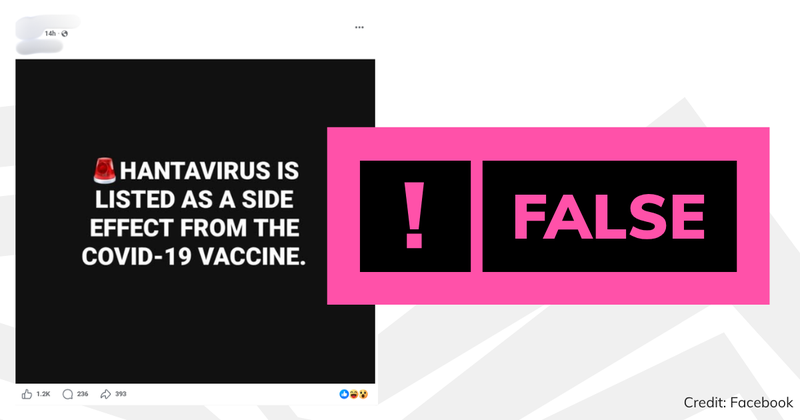
Hantavirus is listed as a side effect of Pfizer’s Covid-19 vaccine.
Our verdict
False. Hantavirus was cited in Pfizer documents as part of a list of adverse events of special interest. These are health conditions researchers monitor during vaccine trials, not side effects.
Widespread social media posts claiming hantavirus is listed as a side effect of Pfizer’s Covid-19 vaccine aren’t correct.
Some posts include a screenshot of a Pfizer document which makes reference to “hantavirus pulmonary infection”.
The posts have been circulating after the recent hantavirus outbreak on a Dutch cruise ship which set sail from Argentina.
But hantavirus is not listed as a side effect caused by the Pfizer Covid-19 vaccine. It’s actually part of a list of adverse events of special interest (or ‘AESIs’), which are health conditions researchers monitor closely during vaccine trials. They do not necessarily have a causal relationship with vaccination.
The document pictured in some of the posts circulating was released in response to a Freedom of Information Act request to the Food & Drug Administration (FDA) in the United States asking it to disclose the data it relied upon to licence Pfizer’s Covid-19 vaccine.
Hantaviruses are a group of viruses which are carried by rodents such as mice and rats and transmitted by their droppings and urine. The UK Health Security Agency says hantaviruses can cause a range of diseases, from mild, flu-like illness to severe respiratory illness. Most hantaviruses are not spread person-to-person, although transmission between humans has happened with one strain of the virus (Andes) in rare cases. The Andes strain is the one identified in the current cruise ship outbreak.
Join 75,000 newsletter subscribers who trust us to check the facts
Sign up to get weekly updates on politics, immigration, health and more.
Subscribe to weekly email newsletters from Full Fact for updates on politics, immigration, health and more. Our fact checks are free to read but not to produce, so you will also get occasional emails about fundraising and other ways you can help. You can unsubscribe at any time. For more information about how we use your data see our Privacy Policy.
Very close and prolonged contact is needed for strains where there is person-to-person transmission, such as people who share living spaces or who may have sat directly next to somebody on a long-haul flight. The UKHSA says the risk to the wider UK population is very low.
Misleading social media posts such as those mentioned above could lead to people making decisions about their health based on false claims. It’s important to consider whether something comes from a trustworthy and verifiable source before you share it. Our Full Fact toolkit can help you do this.
Got a question about hantavirus? Or spotted a claim about it which you'd like us to fact check? Please let us know here.
This article is part of our work fact checking potentially false pictures, videos and stories on Facebook. You can read more about this—and find out how to report Facebook content—here. For the purposes of that scheme, we’ve rated this claim as false because hantavirus was cited in Pfizer documents as part of a list of adverse events of special interest, which are health conditions researchers monitor during vaccine trials, not side effects.
Was this helpful?
Full Fact fights for good, reliable information in the media, online, and in politics.