WHO has not said hantavirus is spreading ‘very fast across the world’

What was claimed
The World Health Organization says that hantavirus is spreading very fast across the world.
Our verdict
False. The WHO has described the outbreak of hantavirus as a ‘cluster’ and said in a press conference that there is no sign it is the start of a larger outbreak.
The World Health Organization (WHO) has not warned that hantavirus is spreading “very fast across the world”, contrary to claims being made on social media.
Posts making this claim have been circulating widely on X and Facebook since the outbreak of the cluster of hantavirus cases aboard the MV Hondius cruise ship. Three of the ship’s passengers have died, two of whom were confirmed to have had hantavirus. There have been eight confirmed, two suspected cases (and one inconclusive case) in total, including two Brits.
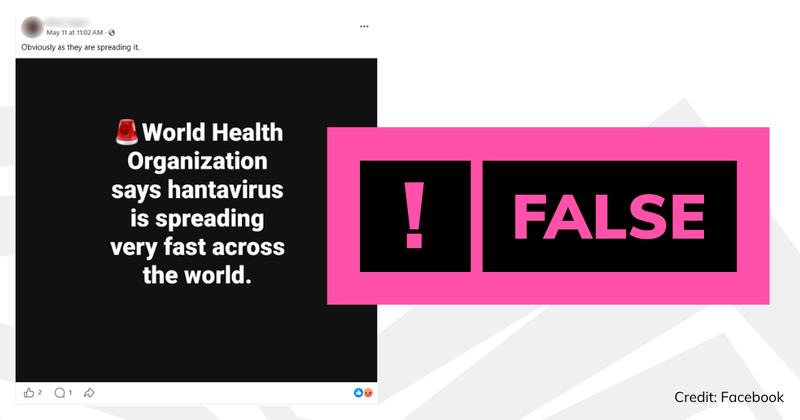
But the WHO has not warned that it is spreading quickly around the world.
In a press conference held in Madrid on 12 May, WHO Director-General Tedros Adhanom Ghebreyesus said: “WHO’s assessment continues to be that the risk to health globally continues to be low.
Join 75,000 newsletter subscribers who trust us to check the facts
Sign up to get weekly updates on politics, immigration, health and more.
Subscribe to weekly email newsletters from Full Fact for updates on politics, immigration, health and more. Our fact checks are free to read but not to produce, so you will also get occasional emails about fundraising and other ways you can help. You can unsubscribe at any time. For more information about how we use your data see our Privacy Policy.
“So far 11 cases have been reported including three deaths. All 11 cases are among passengers or crew on the ship.”
He added: “At the moment, there is no sign that we are seeing the start of a larger outbreak, but of course the situation could change and, given the long incubation period of the virus, it’s possible we might see more cases in the coming weeks.”
On 8 May, the WHO said the risk to the global population was low and for those on the ship it was moderate. It has described the current outbreak as a ‘cluster’.
A spokesperson for the WHO told us that its statements made no mention of the claims in the post.
What is hantavirus?
Hantaviruses are a group of viruses which are carried by rodents such as mice and rats and transmitted by their droppings and urine.
The UK Health Security Agency says hantaviruses can cause a range of diseases, from mild, flu-like illness to severe respiratory illness.
While most hantaviruses are not spread person-to-person, transmission between humans has happened with one strain of the virus (Andes) in rare cases, and this is the strain identified in the current cruise ship outbreak.
The UKHSA says the risk to the wider UK population is very low, with person-to-person contact requiring “close and prolonged contact” with the person who has been infected with hantavirus.
Passengers have now been evacuated from the ship, and some are being quarantined and their symptoms monitored.
We have recently checked another false claim about hantavirus—that it was listed as a side effect of Pfizer’s Covid-19 vaccine. It’s important to consider whether something comes from a trustworthy and verifiable source before you share it. Our Full Fact toolkit can help you do this.
Got a question about hantavirus or spotted a claim about it which you'd like us to fact check? Please let us know here.
This article is part of our work fact checking potentially false pictures, videos and stories on Facebook. You can read more about this—and find out how to report Facebook content—here. For the purposes of that scheme, we’ve rated this claim as false because the WHO has not said that hantavirus is spreading “very fast” across the world.
Was this helpful?
Full Fact fights for good, reliable information in the media, online, and in politics.