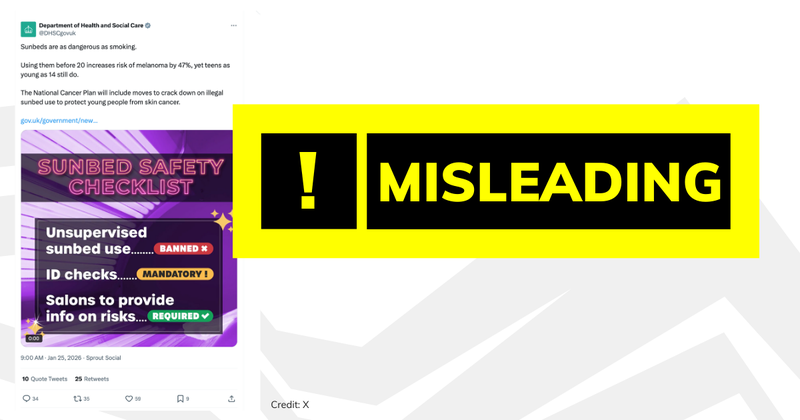
When announcing proposals for stricter sunbed rules last month, the Department of Health and Social Care (DHSC) claimed that they are “as dangerous as smoking”.
This is not supported by the evidence the department used. It’s also misleading, according to the experts we spoke to.
The DHSC claim was based on the classification of both sunbeds and smoking as cancer-causing hazards by the World Health Organisation (WHO). But that doesn’t mean they are equally risky. While precise comparisons are difficult, the experts we spoke to say smoking is much more likely to be harmful.
The DHSC has acknowledged the issue. It told us it believed the wording of its claim could have been clearer to avoid a false equivalence of danger between tobacco and sunbeds. It said that it would use clearer wording in future, but at the time of writing it does not appear to have corrected or deleted any examples of the claim.
As a result, misleading information about the risk of cancer continues to be publicly available on the gov.uk website and the department’s social media channels.
This might not seem important if the DHSC just meant to encourage people to take the dangers of sunbeds seriously. But it matters.
For one thing, it risks making smoking seem less harmful than it is. And perhaps more importantly, it is essential that people feel they can believe what health authorities tell them. When a government shares misleading information about the dangers of sunbeds, it gives people less reason to trust it about other things.
Smoking versus sunbeds
The government made this claim in posts on Instagram, Facebook and on X, where it was shared by both NHS England and the health secretary, Wes Streeting. The DHSC also published an official announcement, which said: “The World Health Organization (WHO) has classed sunbeds to be as dangerous as smoking.”
When we contacted the department about this, it confirmed that the source of the claim was this page from the WHO, which contains a statement from the International Agency for Research on Cancer (IARC) in 2009.
But that statement doesn’t support the claim that sunbeds and smoking are equally dangerous, because of a subtle distinction in IARC’s classifications that has often caused confusion in the past.
In simple terms, scientists at the agency examine the evidence on whether different things (or “agents”) cause cancer in people, and assign them to groups according to how certain we can be about it.
Group 1 lists the agents known to be “human carcinogens”, ie cancer-causing. Group 2A lists agents that “probably” are, group 2B those that “possibly” are, and group 3 those that are not classifiable, because there isn’t enough evidence to put them somewhere else.
The agents in group 1 include obvious things like smoking, asbestos and plutonium, which are known to be very dangerous. But they also include things like eating processed meat, being a firefighter or a painter, hormone-replacement therapy and alcoholic drinks—all of which do raise people’s risk of cancer at least slightly, but not necessarily to the same extent.
The page DHSC shared with us details the announcement in 2009 that “UV-emitting tanning devices” (sunbeds to you and me) had been added to group 1. This does mean that they and smoking are both known to cause cancer—but not that they are necessarily equally likely to, or that they are equally risky overall.
How dangerous are they?
Comparing the dangers of sunbeds and smoking is not easy to do precisely. You’d have to think about how many cigarettes or sunbed sessions people have, as well as when they started, and what the different health effects might be.
In broad terms, however, there are good reasons to think that smoking is much more dangerous than using sunbeds.
The research on which IARC based its decision found that using sunbeds before the age of 30 raises the risk of skin cancer by 75%. Clearly this is an important risk to consider, but the general risks from smoking seem to be far greater.
For example, the US Centers for Disease Control and Prevention (CDC) says: “People who smoke cigarettes are 15 to 30 times more likely to get lung cancer or die from lung cancer than people who do not smoke.” In percentage terms that would mean smoking raises the risk of this cancer by 1,400-2,900%.
And smoking causes other cancers too. The CDC lists “cancer of the mouth and throat, esophagus, stomach, colon, rectum, liver, pancreas, voicebox (larynx), lung, trachea, bronchus, kidney and renal pelvis, urinary bladder, cervix, and acute myeloid leukemia”. Then there are the serious non-cancer risks from heart and circulatory disease, breathing problems and other things.
What the experts say
Cancer Research UK, which does not recommend that people use sunbeds, told us: “The International Agency for Research on Cancer has classified both UV radiation from sunbeds and tobacco in 'Group 1', meaning there is strong evidence both cause cancer. But that doesn't mean they cause the same number of cases of cancer. Tobacco has a much bigger impact on cancer cases.”
Professor Sir David Spiegelhalter, an expert on the public understanding of risk, told us: “Smoking and sunbeds are both hazards, as they both have the potential to cause cancer, which is what IARC are measuring. But that does not mean they present equal risks, since smoking is far more likely to harm you.
“Driving at 30mph and 90mph are both hazards, since both could lead to an accident, but the fast driver is at far more risk. So for anyone to say that ‘sunbeds are as dangerous as smoking’ not only displays a real ignorance of what IARC classifications mean, but is also deeply misleading.”
Kevin McConway, Professor Emeritus of Applied Statistics at the Open University and an adviser to the Full Fact board’s fact checking sub group, told us: “Of course it's wrong to conclude that [sunbeds and smoking] are equally dangerous from the IARC classification. Not that I disagree with IARC that both exposures are definitely carcinogenic in humans, if one is talking (as IARC are) about hazard, not risk.”
Smoking is “way, way more dangerous just in terms of cancers”, he added.
What has Grok said?
While researching this fact check we also noticed that when an X user asked the platform’s AI chatbot, Grok, whether the DHSC claim was true, it said that it was, which is in itself misleading.
We’ve contacted Grok for comment, and will monitor how the information Grok gives changes after the publication of this fact check.