Posts claiming Andy Burnham ‘has no legal right to be Prime Minister’ aren’t accurate

What was claimed
You have to be a member of the House of Lords or an elected member in a general election to become UK Prime Minister. Andy Burnham was neither of these and therefore has no legal right to be Prime Minister.
Our verdict
Incorrect. By modern convention the Prime Minister is an MP, but there is no law that requires them to have been elected in a general election.
Many widely shared social media posts are saying that Andy Burnham MP “has no legal right to be Prime Minister” because he wasn’t elected in a general election.
This isn’t correct. While by modern convention the Prime Minister is an MP, there is no law that specifies they must have been elected to Parliament in a general election.
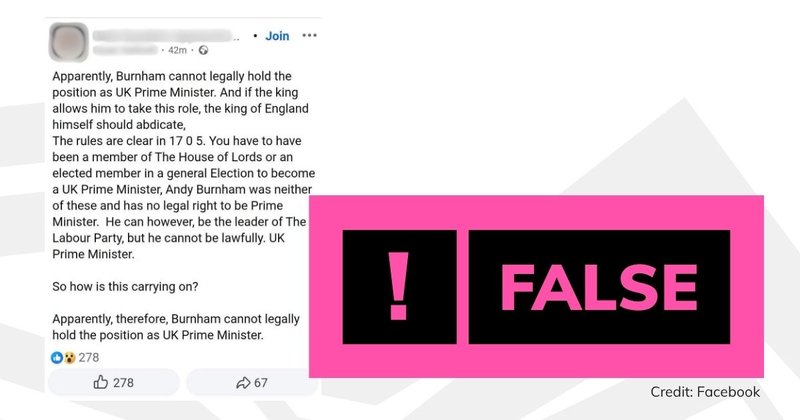
Several posts on Facebook have shared text claiming: “Apparently, Burnham cannot legally hold the position as UK Prime Minister. And if the king allows him to take this role, the king of England himself should abdicate,
“The rules are clear in 17 0 5. You have to have been a member of The House of Lords or an elected member in a general Election to become a UK Prime Minister, Andy Burnham was neither of these and has no legal right to be Prime Minister. He can however, be the leader of The Labour Party, but he cannot be lawfully. UK Prime Minister. [sic]”
Join 75,000 newsletter subscribers who trust us to check the facts
Sign up to get weekly updates on politics, immigration, health and more.
Subscribe to weekly email newsletters from Full Fact for updates on politics, immigration, health and more. Our fact checks are free to read but not to produce, so you will also get occasional emails about fundraising and other ways you can help. You can unsubscribe at any time. For more information about how we use your data see our Privacy Policy.
It’s not clear which rules the text is citing when it refers to “17 0 5”. If this is supposed to refer to rules set out in 1705, no such law or convention from this year exists. Indeed the role of Prime Minister didn’t exist at the time, with Sir Robert Walpole generally viewed as having become the first British Prime Minister in 1721.
The Cabinet Manual, which is the official “guide to laws, conventions and rules on the operation of government”, says that the Prime Minister is appointed “by virtue of his or her ability to command the confidence of the House of Commons”, and that this will normally be the “leader of a political party that commands the majority of the House of Commons”. Prime Ministers have sat in the House of Lords in the past, but today it’s expected that they will either already be an MP or about to become one.
There is no mention in the Cabinet Manual of an MP needing to have been elected in a general election in order to become Prime Minister, however, and we’ve also not seen any credible media reports or claims from other politicians that this is the case. The Institute for Government has also confirmed that Andy Burnham will have a constitutional mandate to become Prime Minister.
The most recent example of someone becoming Prime Minister when they had not been elected as an MP in a general election came in 1963, though at the time he was appointed, Sir Alec Douglas-Home was sitting in the House of Lords. He renounced his peerage and won a by-election to become an MP shortly afterwards.
This article is part of our work fact checking potentially false pictures, videos and stories on Facebook. You can read more about this—and find out how to report Facebook content—here. For the purposes of that scheme, we’ve rated this claim as false because there is no law that requires a Prime Minister to be either a peer or elected as an MP in a general election.
Was this helpful?
Full Fact fights for good, reliable information in the media, online, and in politics.