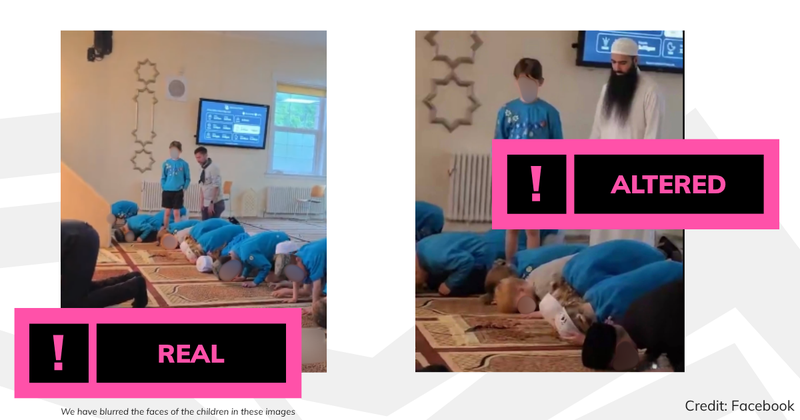
Genuine pictures and footage of a Beaver Scout group visiting a mosque in Scotland, showing several children kneeling and one boy standing up, have gone viral in recent days, with some on social media critical of the visit.
But one widely shared image, which is supposedly from the visit and shows a bearded man in white next to the boy who is standing, is not real—it has been edited.
We have chosen not to directly link to either the genuine or altered imagery in this fact check, and we have blurred the faces of the children in the screengrabs above. But both the genuine and altered imagery have had millions of views across X and Facebook in recent days.
A spokesperson for Scouts told Full Fact the bearded man was “100% not in the original video”.
They said the original video was posted online following the visit. It has since been removed from some social media accounts which posted it, though it continues to be available elsewhere online.
The edited version has other discrepancies: it appears to show two children wearing white hats to the right of the standing boy and another person wearing black clothing. In the footage shared online which the Scouts told us was the original, there are three children wearing white hats on that side instead, and all of them are wearing blue tops.
Some of the posts we’ve seen sharing either the genuine or altered imagery include captions such as “an imam taught the children about Islam, demonstrated how to wear burqas on the girls, and instructed the group to kneel for prayer” and “one young boy refused to kneel”.
We’re not able to verify exactly what the footage shows, or what happened on the visit, but when we spoke to the Scouts they also disputed the way the event had been characterised in some posts.
A spokesperson said: “It wasn't actually a prayer that the Beaver Scouts and leaders were taking part in. The Imam was just demonstrating the actions that are undertaken when Muslims pray. The Beaver Scouts were free to join in if they wished. There was no compulsion… the young people were free to do whatever they wanted.”
Before sharing content like this, first consider whether it comes from a verifiable and trustworthy source. Our guide to spotting AI content, and toolkit on how to identify bad information, can help you do this.