What was claimed
From 2 January 2026, millions of workers will see a brand new £90 deduction called the “Debt Recovery Contribution” appear automatically on their monthly payslips.
Our verdict
False. There are no plans for any such policy.
What was claimed
From 2 January 2026, millions of workers will see a brand new £90 deduction called the “Debt Recovery Contribution” appear automatically on their monthly payslips.
Our verdict
False. There are no plans for any such policy.
Videos viewed hundreds of thousands of times online claim that from January 2026 the government will automatically take off £90 from workers’s payslips each month as part of plans to tackle the national debt.
But this isn’t true. No such policy is being introduced.
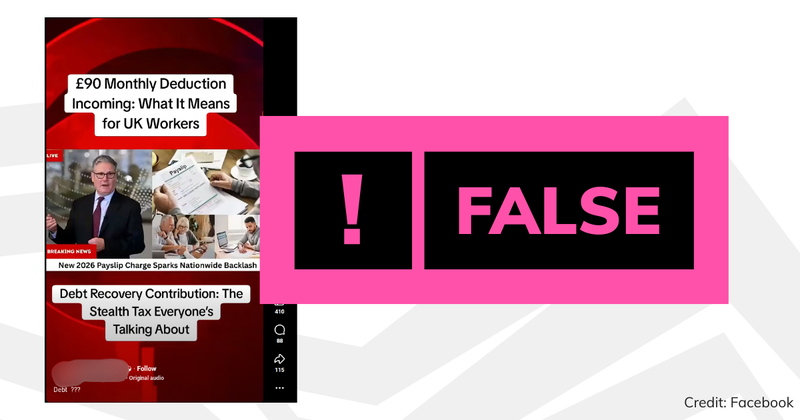
The videos mimic the style of a news presenter, and claim the new deduction, called the “Debt Recovery Contribution”, will be taken from workers payslips directly through His Majesty's Revenue and Customs (HMRC). Only protected groups such as “pensioners, larger families and people on key benefits” supposedly won’t be hit by the deduction.
But searches on gov.uk and Hansard, the record of what is said in Parliament, do not return any results for a “Debt Recovery Contribution”.
Join 73,000 newsletter subscribers who trust us to check the facts
Sign up to get weekly updates on politics, immigration, health and more.
Subscribe to weekly email newsletters from Full Fact for updates on politics, immigration, health and more. Our fact checks are free to read but not to produce, so you will also get occasional emails about fundraising and other ways you can help. You can unsubscribe at any time. For more information about how we use your data see our Privacy Policy.
The unnatural cadence and intonation of the voice in the video also strongly suggests the clip was created using artificial intelligence (AI), although we cannot completely rule out it being created by other means.
HMRC can recover an individual’s tax debts from their bank accounts in specific circumstances. The Direct Recovery of Debts scheme (recently restarted in a ‘test and learn’ phase) can be used when someone owes tax debts of more than £1,000, as long as a minimum of £5,000 is left in their account. This scheme doesn’t allow these debts to be taken from payslips however.
Civil liberties groups and some politicians have also raised concerns over the new Public Authorities (Fraud, Error and Recovery) Act which aims to reduce the amount of money lost to benefit fraud and error. It gives the Department for Work and Pensions (DWP) powers to check and recover money directly from benefit claimants' bank accounts.
But neither of these measures would involve taking £90 out of people’s payslips each month as part of a “Debt Recovery Contribution”.
These videos are part of a spate of false and misleading content about supposed incoming changes to personal freedoms being shared online. We’ve recently written about similar false claims that savings above £5,000 are being taken to pay off the national debt and that the government is introducing a £500 “Christmas Decorations Tax”.
Before sharing information like this that you see on social media, first consider whether it comes from a verifiable and trustworthy source. Our toolkit can help you do this.
Full Fact fights for good, reliable information in the media, online, and in politics.
Bad information ruins lives. It promotes hate, damages people’s health, and hurts democracy. You deserve better.
Subscribe to weekly email newsletters from Full Fact for updates on politics, immigration, health and more. Our fact checks are free to read but not to produce, so you will also get occasional emails about fundraising and other ways you can help. You can unsubscribe at any time. For more information about how we use your data see our Privacy Policy.