Graphene oxide not an ingredient in magnetic antibiotic capsule

What was claimed
Antibiotic flucloxacillin capsules contain graphene oxide that make them magnetic.
Our verdict
False. Graphene oxide is not an ingredient in the medication. The capsule shell contains iron oxide black, which is naturally magnetic, and safe to consume in small amounts.
A video shared on social media claims to show an antibiotic capsule being attracted to a magnet because it contains graphene oxide.
The caption on the post warns: “This my Prescription from the doctors an hour ago…GRAPHENE OXCIDE Metal Conductors [sic].”
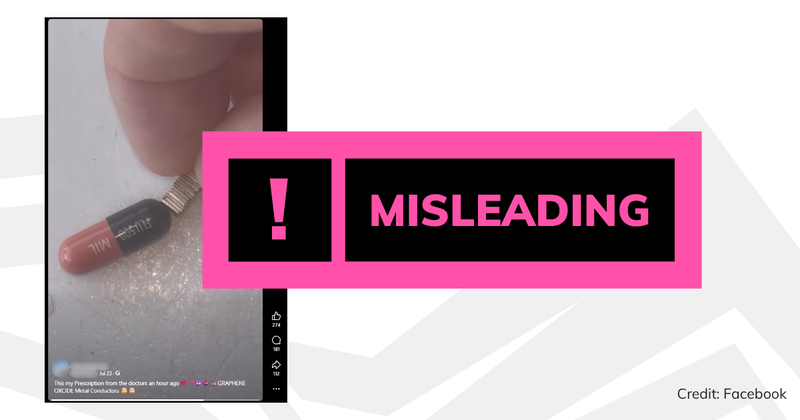
In the video, a person opens a packet of 500mg flucloxacillin tablets, a common antibiotic, and holds a magnet next to one of the red and black capsules. The black end then appears to be pulled along by the magnet.
The speaker in the video asks: “Why are your medicines magnetic, big pharma?”
Join 75,000 newsletter subscribers who trust us to check the facts
Sign up to get weekly updates on politics, immigration, health and more.
Subscribe to weekly email newsletters from Full Fact for updates on politics, immigration, health and more. Our fact checks are free to read but not to produce, so you will also get occasional emails about fundraising and other ways you can help. You can unsubscribe at any time. For more information about how we use your data see our Privacy Policy.
Graphene oxide is a material with a number of uses within biotechnology and in other fields. There is evidence that it can be toxic in certain applications.
But it’s not correct that the magnetism is caused by any graphene oxide being in the medication.
While we have not recreated the experiment ourselves, Full Fact contacted the manufacturer of the flucloxacillin 500mg capsules, Medreich, about the ingredients in the medication and the two halves of the capsule.
Medreich told us that graphene oxide is not included within the Summary of Product Characteristics; a legally approved document that describes a medicine's properties and conditions for safe use.
It also confirmed that the capsule is made of gelatine, with the capsule being coloured with iron oxides, adding: “The Cap composition consists of Iron oxide Black as colorants and Titanium Dioxide as Opacifier. The Body contains Iron oxide Red and Yellow as colorants and Titanium Dioxide as Opacifier.”
Titanium dioxide is used to give a capsule its light or white appearance.
As we previously found, when we fact checked a video making similar claims about the antibiotic amoxicillin, the black end of the capsule is magnetic because of the iron oxide used as a colourant, as iron is generally magnetic.
Medreich also confirmed that the magnetisation is showing “due to the content of Iron oxide Black in the cap of capsule shell”, which contains a “minimal quantity” of approximately 3.37mg per capsule.
Iron is a normal part of the human diet, and although iron poisoning can occur—the quantity of iron oxide used in these tablets, with a maximum allowable daily dose of four tablets, is significantly below the threshold of what would constitute a toxic dose.
Bad information about medications can lead to people making harmful decisions about their treatment.
This article is part of our work fact checking potentially false pictures, videos and stories on Facebook. You can read more about this—and find out how to report Facebook content—here. For the purposes of that scheme, we’ve rated this claim as false because graphene oxide is not an ingredient in the antibiotic flucloxacillin. It has a magnetic reaction because of the black iron oxide used to colour part of the capsule.
Was this helpful?
Full Fact fights for good, reliable information in the media, online, and in politics.