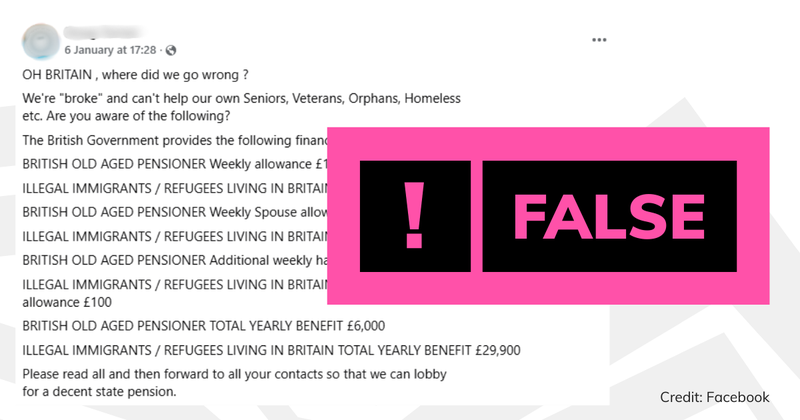
A series of figures comparing the amount pensioners receive in financial assistance from the government with the amount received by “illegal immigrants/refugees living in Britain” is circulating again on Facebook.
We’ve seen variations of these posts being shared on social media for over a decade—the figures in them are still wrong.
The posts claim:
“The British Government provides the following financial assistance: -
BRITISH OLD AGED PENSIONER Weekly allowance £106
ILLEGAL IMMIGRANTS / REFUGEES LIVING IN BRITAIN Weekly allowance £250
BRITISH OLD AGED PENSIONER Weekly Spouse allowance £25
ILLEGAL IMMIGRANTS / REFUGEES LIVING IN BRITAIN Weekly Spouse allowance £225
BRITISH OLD AGED PENSIONER Additional weekly hardship allowance £0.00
ILLEGAL IMMIGRANTS / REFUGEES LIVING IN BRITAIN Additional weekly hardship
allowance £100
BRITISH OLD AGED PENSIONER TOTAL YEARLY BENEFIT £6,000
ILLEGAL IMMIGRANTS / REFUGEES LIVING IN BRITAIN TOTAL YEARLY BENEFIT £29,900”
The state pension is higher than the “total yearly benefit” figure for pensioners listed in the post, while people who are in the UK without the right to be here are not entitled to public funds.
Asylum seekers (who we often see referred to as “illegal immigrants”) are entitled to some financial support from the government, but not as much as claimed in these posts. Refugees in the UK can claim benefits on the same basis as UK citizens, but they’re not entitled to the amount claimed in these posts by virtue of their refugee status.
Support for pensioners
The posts claim pensioners receive a “weekly allowance” of £106, a “weekly spouse allowance” of £25 and no “additional weekly hardship allowance”, for a total of £6,000 in “total yearly benefit”.
The amount of state pension you receive depends on when you were born, but both the full new and basic state pensions pay more than the figures included in the posts.
People who receive the full “new state pension” currently get £230.25 per week (£11,973 per year), while people who receive the full “basic state pension” get £176.45 per week (£9,175 per year).
There’s no benefit called the “additional weekly hardship allowance” but there are additional forms of means-tested support available to some pensioners, including pension credit and housing benefit.
Some pensioners are also eligible for additional support like the Winter Fuel Payment and free TV licenses.
There is also no specific “weekly spouse allowance” for pensioners, although some older pensioners may be eligible for the Married Couples Allowance.
What about “illegal immigrants”?
The posts don’t specify who is meant by “illegal immigrants”.
Broadly speaking, people who are in the UK without the right to be here are not eligible to receive public funds, including mainstream benefits.
However, we often see the term “illegal immigrants” used when referring to asylum seekers, who can receive some financial assistance from the government, as well as being provided with accommodation, although they are not eligible for mainstream benefits.
Asylum seekers who have to provide their own meals receive £49.18 per week (£2,557 per year), while those who are housed in accommodation where meals are provided, such as hotels, receive £9.95 per week (£517)—far less than the amount claimed in the posts.
There are additional payments available to new or expectant mothers, but there’s no “weekly spouse allowance”.
Our Frequently Asked Questions page has more detailed information on the support available to asylum seekers.
Support for refugees
People who have been granted refugee status in the UK are entitled to claim benefits on the same terms as UK citizens.
It’s therefore possible in theory that a refugee household could receive £29,900 a year in benefits, as UK citizens could. But this would only happen if they weren’t subject to the benefit cap, which currently ranges from £283.71 per week (£14,753 per year) for a single adult living outside of Greater London, to £486.98 per week (£25,323 per year) for a couple or single parent whose children live with them in Greater London.
Even if a refugee household were to be exempt from the benefits cap and did receive £29,900 a year, this would be based on the same eligibility criteria as a UK citizen—they wouldn’t be entitled to this amount by virtue of their refugee status.