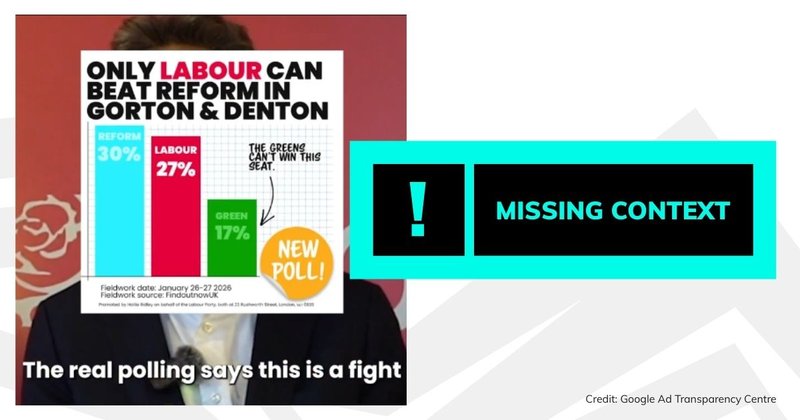
An advert shared by the Labour Party features energy secretary Ed Miliband claiming that the “real polling” shows that the upcoming by-election in Gorton and Denton is a “fight between Labour and Reform”.
It also includes a bar chart, which shows Reform UK on 30%, Labour on 27% and the Green Party on 17%, underneath the claim “only Labour can beat Reform in Gorton & Denton”.
But the poll quoted has a very small sample size, with the figures in the bar chart based on responses from just 62 people, and the organisation which conducted the survey has said that while its findings suggest the vote will be close, they should not be analysed beyond that.
Polling experts have also told Full Fact that the poll cannot reliably show how support for the main parties compares, and have cautioned more broadly about a lack of reliable polling data on the by-election.
What does the poll show?
The poll cited in the YouTube ad was carried out between 25 and 27 January by FindOutNow, a polling and consumer research company which is a member of the British Polling Council.
It had a total sample size of 143. But the figures shown in Labour’s bar chart are based on a subset of that sample—the 62 respondents who said they were definitely or very likely to vote in the by-election.
Of those respondents, 30% said they would vote for Reform UK, 27% for Labour, and 17% for the Green Party. (The figures Labour ran in its ad). A further 6% said they’d vote for the Conservatives, and 2% for the Liberal Democrats, with 18% ‘Don’t know’.
Labour’s ad does cite FindOutNow as the source of the poll, but makes no mention of the number of respondents.
In a statement accompanying the findings published on 28 January, FindOutNow said that due to the small sample size and the by-election being a month away with not all candidates yet selected at the time the poll was conducted, “the margin of error will be larger” than a regular voting intention poll.
In a subsequent statement on 30 January, the company said: “Although the poll suggests the race is likely to be close, it should not be analysed beyond that (for example, as indicating that one party is in the lead).”
It’s not clear when the ad featuring Mr Miliband was first published. However given it references Labour’s candidate Angeliki Stogia, who was confirmed on 31 January, it appears it was after this clarification from FindOutNow. The same graph was also used by Labour in an ad on Facebook and Instagram between 4 and 5 February.
Another ad which appears to have run on Facebook and Instagram between 8 and 10 February features a slightly different graph based on results from the same poll, excluding people who answered ‘don’t know’ (reducing the sample size even further).
Professor Rob Ford, a political scientist at the University of Manchester, told Full Fact that he did not believe the poll results were reliable due to the small sample size, adding: “The claims based on it are therefore not credible.”
Anthony Wells, global head of politics, elections and public data at the polling company YouGov, said that the low sample size and high margin of error in the poll made it “impossible to draw any reliable conclusions about the relative position of the main parties”.
We’ve contacted Labour and Mr Miliband for comment.
Is there any reliable polling data from Gorton and Denton?
Labour is not the only party to have said it is the “only” one that can beat Reform UK in Gorton and Denton. At the end of last month we fact checked a similar claim from the Green Party, and our fact check of that claim is quoted in the Labour ad which is the subject of this check.
Both the polling experts we spoke to said that they were not aware of any reliable polling data from the seat, however.
Professor Ford said: “Both parties really want to be able to claim the mantle of the main "anti-Reform" party in the seat but the truth is there is no reliable data available, from polling or other sources, which can be used to decisively evidence such a claim.”
Mr Wells also said that he was not aware of any reliable polling data for the by-election, and warned there were various limitations to things that may be “presented or misrepresented as ‘polling data’ at by-elections”.
For example, projections of vote shares in a particular seat based on national polling or MRP modelling (which typically is based on how people would choose to vote in a general election rather than a specific by-election) may not take account of local factors, he said, while figures based on canvassing data or responses to local party leaflets are not the same as polling and are unlikely to be representative.
Mr Wells also noted that while it was possible a company could produce a more comprehensive constituency poll ahead of the by-election, the demographics of Gorton and Denton make polling in the constituency difficult.
He said: “It is a constituency with distinct communities that are likely to vote and behave in different ways and care about different issues, so it wouldn’t just be a case of getting age, gender and the basics right—it would also be [necessary] to get the different parts of the seat in the right balance and properly represent the ethnic and religious mix of the seat.”