The Gorton and Denton by-election: fact checked
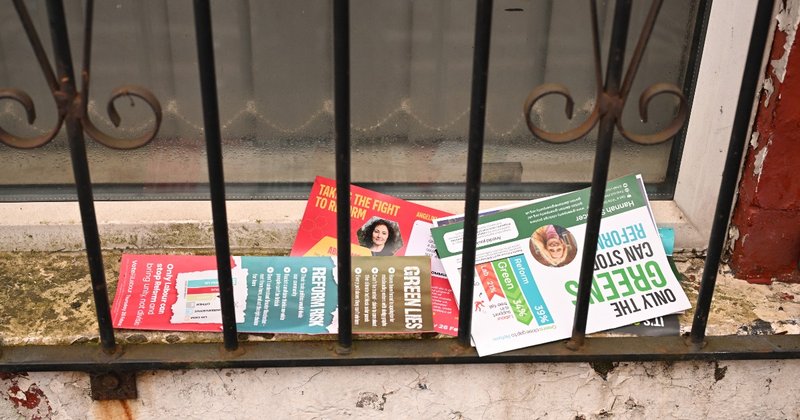
Voters in Gorton and Denton head to the polls on Thursday in what is widely being viewed as a three-way contest between the Green Party, the Labour Party and Reform UK. (A full list of candidates is available here.)
This by-election has attracted significant attention in the national media, in part due to Labour’s decision to block Greater Manchester mayor Andy Burnham from standing to be the party’s candidate, but also because of its perceived wider political implications.
Full Fact has covered the by-election campaign in some detail, publishing six fact checks so far, looking both at online claims and those made on the ground, on flyers and posters.
We’ve examined misleading or questionable claims from all three of the parties seen as most likely to win the seat, and debunked false claims circulating on social media. We’ve also seen some of our fact checking quoted by some of the campaigns themselves—in one case with a caption that did not reflect the findings of our fact check verdict.
Here’s a round up of some of the claims we’ve seen being made.
Join 73,000 newsletter subscribers who trust us to check the facts
Sign up to get weekly updates on politics, immigration, health and more.
Subscribe to weekly email newsletters from Full Fact for updates on politics, immigration, health and more. Our fact checks are free to read but not to produce, so you will also get occasional emails about fundraising and other ways you can help. You can unsubscribe at any time. For more information about how we use your data see our Privacy Policy.
Dodgy bar chart claims
Misleading, confusing or unreliable bar charts are a regular feature of election campaigns—we’ve been fact checking them for well over a decade. And in the current by-election campaign we’ve written about a couple of claims attached to bar charts.
At the end of January the Green Party used one such bar chart to claim that the “latest polling” showed that “only the Greens can stop Reform”. The bar chart in question (which featured rounding errors) showed the Election Maps UK model’s projected change in vote share compared to the 2024 general election.
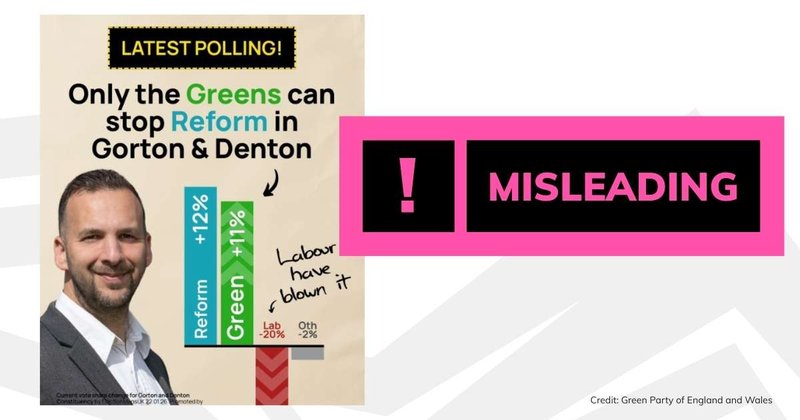
It was misleading to suggest that this model showed “only the Greens can stop Reform” however, or to quote only its change in vote share figures, because the same model’s figures for actual projected vote share at the time the post was shared showed Labour winning and the Greens coming in third.
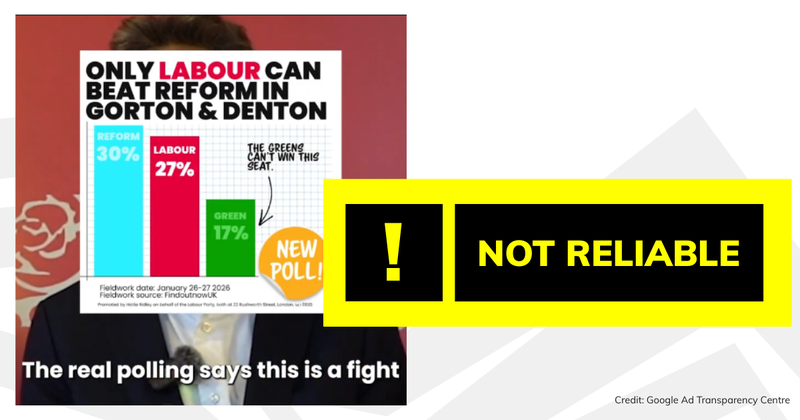
Labour, meanwhile, has also claimed polling shows it’s best placed to beat Reform. But as we explained, the poll it quoted in some of its by-election ads wasn’t a reliable source for this claim, because it had a very small sample size. In fact, the figures in its bar chart were based on just 62 respondents.
We’ve seen multiple versions of Labour ads referencing data from this poll, which was carried out by FindOutNow in late January.
FindOutNow itself said that while its poll’s findings suggested the vote will be close, the small sample size means they should not be analysed beyond that. And experts we spoke to told us the poll couldn’t be reliably used to make claims about how support for the main parties compares.
What’s more, they warned that there is limited reliable polling data to support claims about who the top two challengers in the by-election are likely to be.
Professor Rob Ford, a political scientist at the University of Manchester, told us two weeks ago: “Both parties really want to be able to claim the mantle of the main "anti-Reform" party in the seat but the truth is there is no reliable data available, from polling or other sources, which can be used to decisively evidence such a claim.”
Since we spoke to Mr Ford at least one other constituency poll of Gorton and Denton voters has been published. This survey puts all three main candidates within four percentage points of each other when people who said they would not vote are excluded—within the margin of error for the poll.
Anthony Wells, head of global politics, elections and polling at YouGov, warned there were various limitations to things that may be “presented or misrepresented as ‘polling data’ at by-elections”.
For example, he told us that projections of vote shares in a particular seat based on national polling or MRP modelling (which typically is based on how people would choose to vote in a general election rather than a specific by-election) may not take account of local factors; however by-elections are more likely to be influenced by local issues and campaigning. Figures based on canvassing data or responses to local party leaflets are also not the same as polling and are unlikely to be representative.
It’s possible this kind of data might be behind figures featuring in ads promoted by the Green Party, which used responses to a survey of “local residents” to claim that “only the Greens can beat Reform”. In a video, the party’s candidate Hannah Spencer said that the results were based on “nearly 2,000 chats on the door in Gorton and Denton”. We’ve asked the Greens for more details on how this data was collected.
Reform UK has similarly claimed that the contest is a “two-horse race” between itself and the Greens in its own campaign literature—again, we’ve asked what this is based on.
UK Polling Report also told us that “single-constituency polling is notoriously difficult”.
All this means that claims from any of the parties about who is projected to win—or who is projected to come second—should be treated with a heavy dose of caution.
Other claims
We’ve also fact checked a claim made on a campaign flyer circulated by Reform UK, which claimed that “350 illegal boat migrants” live in Gorton and Denton.
This is a broad estimate extrapolated from council-level data showing the number of asylum seekers receiving support from the government last September—the leaflet presents the figure as fact without making this clear, which we’ve said is misleading. We don’t know exactly how many asylum seekers or people who arrived by small boat crossing are living in Gorton and Denton currently.
And much earlier in the campaign we saw a fierce row between Reform UK and Labour over a campaign video.
Labour shared 2023 footage of Reform’s candidate, Matt Goodwin, saying he was “unfortunate enough to be in Manchester a few days ago”. The clip included text saying: “This is what Reform’s latest candidate thinks about where he’s standing to represent.” Reform said this was misleading, with Mr Goodwin saying he had been referring instead to the Conservative party conference, which he had attended in Manchester a few days before the footage was filmed.
As we wrote at the time, fact checking claims such as this can be difficult, because it is the underlying meaning of the comments in question which may be disputed. But you can read our analysis here, which includes full details of what we know about the context of Mr Goodwin’s comments in 2023.
False claims on social media
We haven’t just fact checked claims from politicians during the campaign—we’ve also fact checked false claims about them which we’ve seen circulating on social media.
Posts which gave the wrong name for the Green Party candidate gained thousands of reactions on Facebook and X ahead of the real candidate being announced. At the time these posts were shared, the Greens’ hadn’t confirmed a candidate, and we found no evidence that the person named in the posts was being considered by the party for this by-election.
And we also saw false claims that Reform UK had edited its own placards into an image of a house in Gorton and Denton spread rapidly on social media. As our fact check explained, the claims were shared with a separate image which itself appeared to have been edited.
How Full Fact’s fact checks have been shared by the campaigns
Perhaps unsurprisingly in such a hard-fought campaign, we’ve also seen our fact checks shared widely after publication, not only in the media but in some cases by the campaigns themselves.
Our fact check of the Greens’ misleading bar chart claim was used prominently by Labour in its own campaigning, and not always straightforwardly.
It was quoted accurately in an open letter from Labour’s deputy leader Lucy Powell, and in a campaign video by energy secretary Ed Miliband.
But we also saw it referenced in a concerning way in social media adverts paid for by the Labour party.
The adverts featured a screengrab of Full Fact’s X post about our fact check of the Green Party’s claim, below a caption which says “FACTCHECK: Only Labour can stop Reform in Gorton and Denton”.
But that’s not what our fact check said. While the Green Party’s bar chart claim failed to make it clear that the model cited had suggested Labour would win overall, that does not mean we concluded that only Labour can “stop Reform”. As we explained at the time, we had no way of verifying the accuracy of the model and made no assessment of which party is most likely to win in Gorton and Denton.
Our fact check debunking false online claims about Reform UK editing images of a house was also shared on X by the party’s candidate, Mr Goodwin.
Somewhat confusingly though, this fact check was then inaccurately cited by the xAI chatbot Grok, after Mr Goodwin posted a completely different, apparently AI-generated, picture of a house supposedly plastered in Reform posters, seemingly mocking the original false online claims.
Asked by X users if the newer, altered image was in fact genuine, Grok claimed that it was—based on our fact check of the first, entirely unrelated image.
More elections in May
While there are now only a couple of days to go until voters in Gorton and Denton go to the polls, more elections are on the horizon.
On 7 May millions will be heading to the ballot box for the Scottish and Welsh parliamentary elections, as well as local elections in England—and we’ll be covering the campaigning in the weeks before in the same way we’ve been scrutinising the current contest in Greater Manchester.
We know elections are closely fought, and everyone is scrambling for advantage, but it is incumbent on politicians to present the facts as accurately as possible. Otherwise public trust is diminished in a way that harms democracy.
As always, if you see something you think we should write about, or you’d like us to fact check, please let us know.