Scottish Labour bar charts in Edinburgh and Glasgow leaflets aren’t reliable projections for Holyrood election

What was claimed
Bar charts show Scottish Labour ahead of the SNP in two Scottish parliamentary constituencies in Edinburgh and Glasgow.
Our verdict
These bar charts don’t give a reliable picture of parties’ likely standings in the upcoming Scottish parliamentary elections. They are labelled as showing projected results based on the 2024 general election, and data from that election can’t reliably tell us about the likely outcome of the 2026 Holyrood contest.
Bar charts in Scottish Labour campaign leaflets which show the party ahead of the SNP in two Scottish parliamentary constituencies in Edinburgh and Glasgow do not give a reliable picture of parties’ likely standings locally.
We were asked about the Edinburgh leaflet by Full Fact reader Julie, who flagged it via our elections tip line.
The bar charts are labelled as “projected results” or a “projection” based on the 2024 general election results. Scottish Labour told us the bar chart in its Edinburgh leaflet was based on “internal data” it had “broken down to polling district level” in order to match Scottish parliamentary constituency boundaries. It’s unclear if the same methodology was used in the Glasgow leaflet.
In any event though, 2024 general election results cannot reliably predict the outcome of the 2026 Holyrood elections, as we explain below.
Join 75,000 newsletter subscribers who trust us to check the facts
Sign up to get weekly updates on politics, immigration, health and more.
Subscribe to weekly email newsletters from Full Fact for updates on politics, immigration, health and more. Our fact checks are free to read but not to produce, so you will also get occasional emails about fundraising and other ways you can help. You can unsubscribe at any time. For more information about how we use your data see our Privacy Policy.
What the leaflets said
The leaflet shared with us by Julie was for the Scottish parliamentary constituency of Edinburgh South Western (shown immediately below), while we’ve also seen another chart for the Glasgow Cathcart and Pollok constituency.
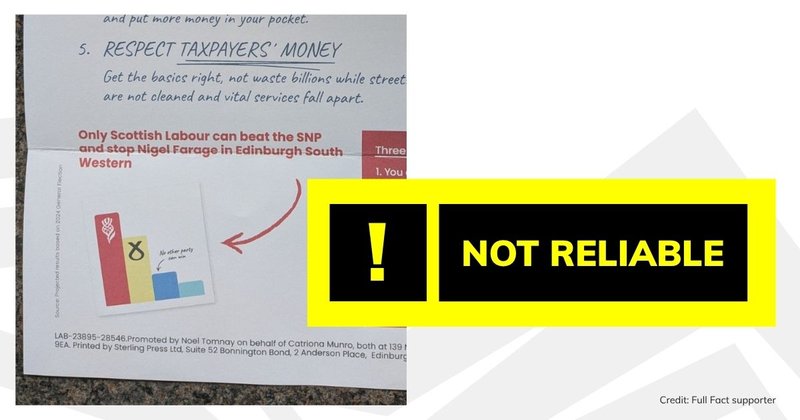
The Edinburgh leaflet gives as a source for the charts “Projected results based on 2024 General Election”, while the Glasgow leaflet says “Projection based on 2024 general election result”. However they do not say who produced these projections, and don’t include specific figures for each party.
When we contacted Scottish Labour to ask for this information, it gave us a response relating to the Edinburgh leaflet, and said: “The bar graph is based on our internal data collected at the 2024 election and count broken down to polling district level. As the boundaries of [the Westminster constituency] Edinburgh South West and [the Holyrood constituency] Edinburgh South Western differ, only the data from the polling districts included within the Scottish Parliament constituency is taken into account.
“Based on our data, the result in 2024 using the new Scottish Parliamentary boundaries would have seen Labour in first, the SNP in second, with the Conservatives and Reform a distant third and fourth. In order to preserve the readability of the graph, only the parties with the highest projected share of the vote in 2024 have been included.
“As there have been significant boundary changes since the last Scottish Parliament election, this is the only accurate method of displaying results on the new boundaries at the most recent national election.”
We did not receive a response from Scottish Labour relating to the Glasgow leaflet (shown below).
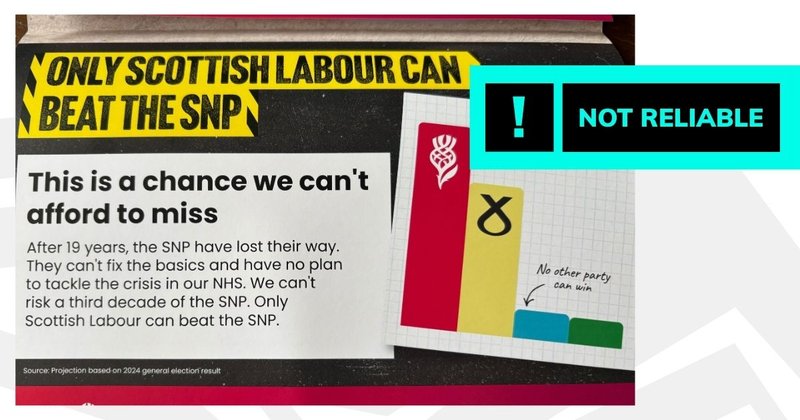
Holyrood parliamentary constituencies do not always directly overlap with Westminster parliamentary constituencies in Scotland, which is why in Edinburgh at least Scottish Labour appear to have relied on their own district-level polling data—but the fact that it has used its own “internal data” means the figures are impossible for us to verify.
And even if Scottish Labour’s data does accurately show how people voted in the Holyrood constituency area, 2024 general election results are not a reliable indicator of how people are likely to vote in the 2026 Scottish parliament elections.
As we wrote last month, polling experts caution against using general election results to predict the outcome of other elections because people may choose to vote in different ways, or turnout may be different—and similar considerations apply in this case.
There are a number of reasons why people may choose to vote differently in a UK general election compared to a Scottish parliamentary election. For example, the candidates and the voting system are different (in Scotland, voters elect both constituency MSPs and regional MSPs), and there are specific issues devolved to the Scottish parliament that may influence people’s choices in these elections, but not in general elections.
Plus of course a lot may have changed in politics in the last couple of years which could affect the way people choose to vote.
More recent polling which specifically looks at voting intention in the upcoming Scottish parliamentary elections produces markedly different projections for these seats than shown in the bar charts produced by Scottish Labour. Whereas Scottish Labour’s bar charts show them ahead of the SNP, the more recent polling projects comfortable wins for the SNP in each seat.
The polling and political analyst Peter Kellner, the former chairman of YouGov, told us that there was no exact past comparison for Edinburgh South Western, and that MRP modelling at constituency level was also “not at all reliable”.
In response to the 2024 general election figures cited in Scottish Labour’s bar charts, he added: “Even if their 2024 figures are correct, they are the least relevant, not least because of the slump in Labour’s support since the general election. But given the rise in Reform and the Greens, there’s a good case for ignoring all past data.”
Was this helpful?
Full Fact fights for good, reliable information in the media, online, and in politics.