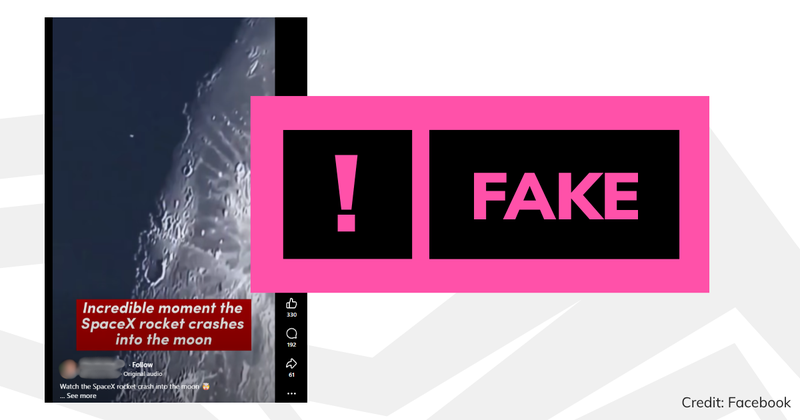
A striking video apparently showing the moment part of a SpaceX rocket collided with the moon has been going viral on social media.
But experts have told Full Fact that the video is fake, it is inconsistent with the moon’s real topography and the location of the rocket’s impact, and it was probably generated with AI. And SpaceX founder Elon Musk has also said that it is not real, after sharing the clip on X.
The clip, which has gained millions of views on X, appears to show a section of one side of the moon, with an object travelling directly towards it, hitting it and causing a mushrooming white cloud.
But while the empty upper stage of a Falcon 9 rocket that launched in January last year did collide with the moon on 5 August, this isn’t real footage of that event.
We couldn’t find any evidence that this clip was being used by verifiable and credible news or scientific outlets in their reporting of the rocket crash.
And when we contacted astronomy experts to get their views on the clip, they all agreed that it wasn’t genuine.
‘That’s not even the moon’
Dr Matt Bothwell, public astronomer at the University of Cambridge, told us that he had “essentially 100% confidence” that it was an AI fake video.
He added there was “no way for any telescope to actually resolve the incoming rocket”, and said he was not aware that there were any images of the actual impact.
“The rocket itself was around 12 metres long, which at the distance of the moon—370,000 kilometres or so—would have an angular size of about 0.007 arcseconds. There’s no telescope on Earth big enough to resolve something that small. Seeing the incoming dot heading for the moon would be literally impossible for any telescope that exists,” Dr Bothwell said.
Dr Eamonn Kerins, astrophysicist and Reader in Physics and Astronomy at the Jodrell Bank Centre for Astrophysics at the University of Manchester, told us the video was “fake” and said he had “little doubt the video must be AI-generated, not least because I was watching an online livestream of the lunar surface at the time at similar magnification and saw nothing”.
He added that the real location of the impact, which was expected near the Einstein crater, doesn’t appear to be correctly depicted.
And Carl Schmidt, planetary scientist at Boston University's Center for Space Physics, simply told us: “It’s certainly a fake. That’s not even the moon!”
Dr Greg Brown, astronomer at the Royal Observatory Greenwich, said the crash “would not have produced anywhere near the size of impact shown here—nor would the SpaceX craft have been visible in the way it is in the video”.
What could be seen?
South Korea’s space agency has released images showing the aftermath of the crash on the moon’s surface, which are nowhere near as detailed as the fake video.
It’s also been reported that a telescope in Chile at the European Southern Observatory managed to observe “spectral lines” of gases in the resulting dust plume.
But this is very different to a full video of the impact.
As this BBC video also explains, there were no satellites in the right place at the right time to observe the crash, although they will now be able to capture images of the aftermath, and the new crater.
We have previously fact checked other suspected AI-generated content which has been shared on social media with claims it shows events or discoveries in space. Before sharing content like this, it’s important to consider whether it comes from a trustworthy and reliable source, and our Full Fact misinformation toolkit contains tips to help you do this.