Viral imagery of Pink Panther protester in France is AI-generated

What was claimed
Images and videos show a person dressed in a Pink Panther costume taking part in the current protests in France.
Our verdict
These particular images and videos have been generated using artificial intelligence. They all contain an AI watermark and telltale clues such as garbled text and reusing old photos from other protests.
Viral social media posts supposedly showing imagery of a person in a Pink Panther costume taking part in the recent protests in France are not real.
The images and videos of the cartoon character throwing a molotov cocktail, raising his middle fingers up in a crowd and running from a water cannon, have been shared thousands of times as if they were genuine.
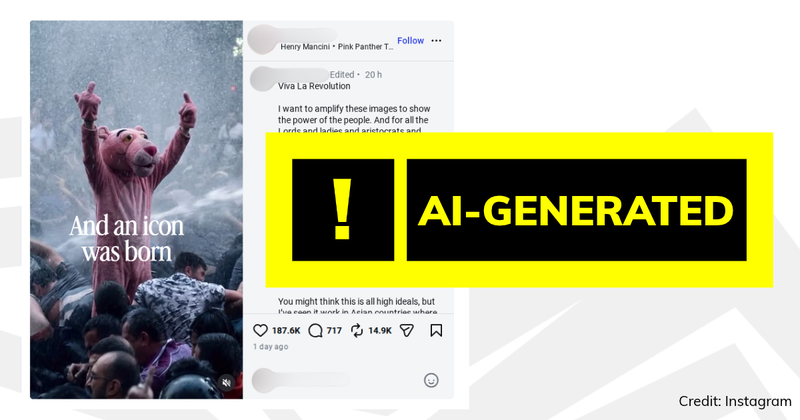
There are many different examples circulating online, however all the examples that Full Fact has checked appear to contain either invisible SynthID watermarks, indicating they were made or edited with Google’s AI or OpenAI tools or flag as having been made with Meta’s AI.
But that’s not all. They also contain visual clues that point to them having been manipulated.
Join 75,000 newsletter subscribers who trust us to check the facts
Sign up to get weekly updates on politics, immigration, health and more.
Subscribe to weekly email newsletters from Full Fact for updates on politics, immigration, health and more. Our fact checks are free to read but not to produce, so you will also get occasional emails about fundraising and other ways you can help. You can unsubscribe at any time. For more information about how we use your data see our Privacy Policy.
One of the images that appears to show Pink Panther in the centre of a crowd with his middle fingers raised can actually be traced back to an original photo from protests in Armenia in 2015. The people sitting on the ground in the front of the image all match up, while a standing protester in the Armenian capital Yerevan has been swapped for the person in the Pink Panther suit.
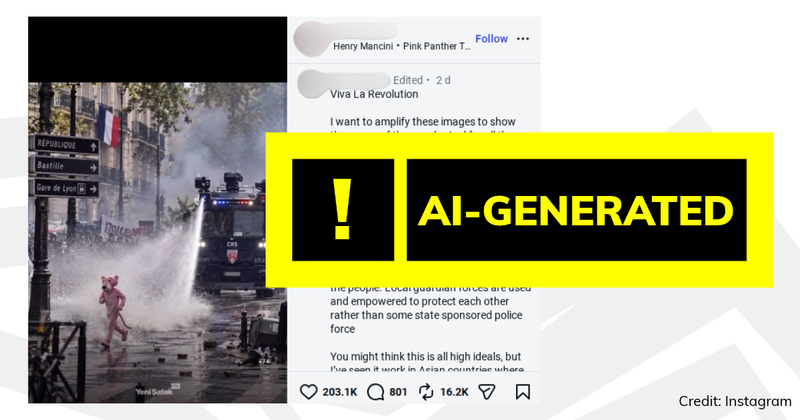
Another viral picture showing the Pink Panther running away from a large riot van in the streets of Paris also contains garbled text on banners in the background, bin and logo of the vehicle—a telltale sign of AI-generated images. It also flags as having been made with OpenAI’s tools.
The black vehicle also doesn’t appear to match other verified footage and photos of the riot vans with water cannons being used in the recent French protests. However, it appears to match very closely with a genuine photo of people running away from a vehicle using a water cannon at a demonstration in Kenya in 2025.
A video version of that Pink Panther clip, where the person in the suit runs and looks back at the van flags in Google’s SynthID detector tool as having been “made or edited with AI from a SynthID partner”.
Another video of the costumed protester supposedly running over a crossing as a water cannon fires flags as having “AI signatures” and being “created using Generative AI” in Meta’s detector. Both video clips have other notable errors, including that the person’s feet seem to be running through water that appears much deeper than the rest of the visuals imply.
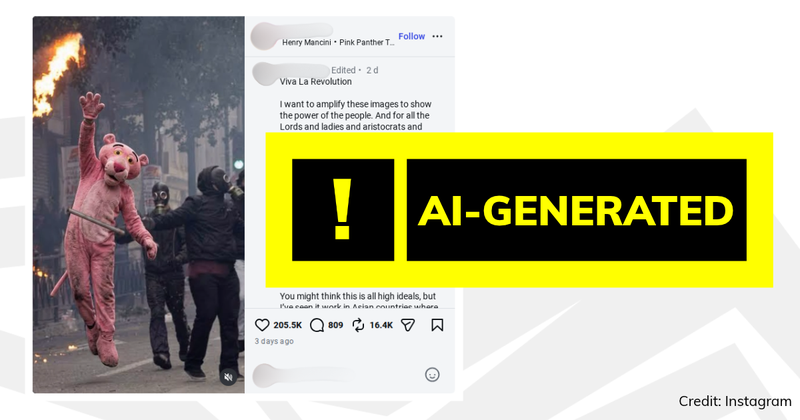
An old photo of protests in Greece was also used to create another fake image of the Pink Panther protester jumping in the air to throw a fiery molotov cocktail. The actual photo was taken during clashes in central Athens in December 2010.
Though the recent mass protests in France have been well documented, not all of the scenes being shared on social media are genuine. We have previously fact-checked other AI-generated imagery claiming to show huge Palestinian and Jordanian flags being flown from the top of the Eiffel Tower and social media users sharing old videos of disorder as the student protests.
We used Google’s SynthID detector extensively as part of this article, but we never rely on that tool alone to conclude something was made or edited with AI. You can read about why in our recent investigation.
During breaking news events it can be difficult to differentiate between authentic and fake images. Our Full Fact toolkit contains tips on how to check whether something comes from a trustworthy and verifiable source before sharing.
This article is part of our work fact checking potentially false pictures, videos and stories on Facebook. You can read more about this—and find out how to report Facebook content—here. For the purposes of that scheme, we’ve rated this claim as altered because the images and videos have been created using artificial intelligence.
Was this helpful?
Full Fact fights for good, reliable information in the media, online, and in politics.