Fake image of Ryanair plane after passenger was nearly sucked out of window circulates

What was claimed
An image shows the destroyed cabin window on a Ryanair flight on 10 July after an incident where a passenger was partially sucked out of the plane.
Our verdict
The image is not genuine. It is an AI-generated fake containing an invisible watermark indicating it was made with OpenAI tools, and the depicted damage—such as a destroyed window frame and glass covering the seats—does not match real photos and videos of the incident.
An image apparently showing a severely damaged window on a Ryanair plane following an incident in which a passenger was almost sucked out mid-flight is not genuine.
A 61-year-old Serbian man, Ljubisa Karović, was involved in the incident on 10 July which saw the acrylic window next to his seat reportedly smashed, and his wife, Svetlana Grković, holding on to his legs and pulling him back with the help of two other passengers.
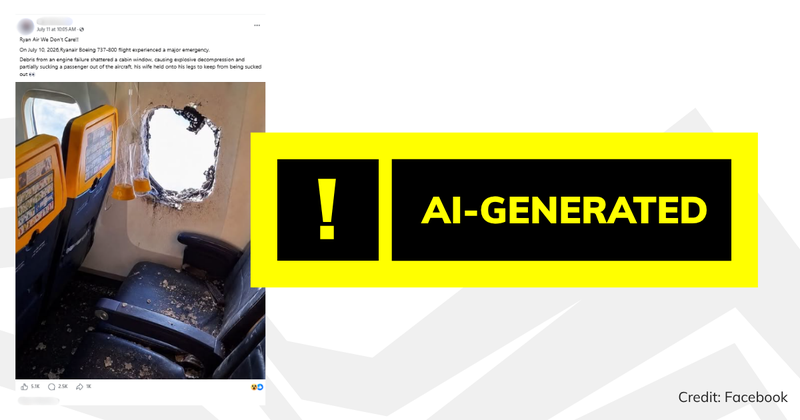
There are real images and video footage of the damage on the Ryanair flight, which was travelling from Greece to Germany, and early probes suggest that this was caused by “foreign object damage” to the engine upon take-off, according to the firm’s CEO.
But the above picture being widely shared on social media is an AI-generated fake.
Join 75,000 newsletter subscribers who trust us to check the facts
Sign up to get weekly updates on politics, immigration, health and more.
Subscribe to weekly email newsletters from Full Fact for updates on politics, immigration, health and more. Our fact checks are free to read but not to produce, so you will also get occasional emails about fundraising and other ways you can help. You can unsubscribe at any time. For more information about how we use your data see our Privacy Policy.
That picture shows what seems to be the inside of a Ryanair cabin and a broken window, but it does not match the real photos of the damage. The AI-generated image appears to show the entire frame of the window has been destroyed, and broken glass covers the seats, none of which is visible in the genuine scene pictures.
We found the fake image also contained an invisible SynthID watermark indicating it was “generated with OpenAI tools” such as ChatGPT, the OpenAI API or Codex.
There are also differences between this picture, and the way parts of the plane, such as the footwell area and the oxygen masks, appear compared to real images.
His wife and other passengers reported that while the man had his seatbelt on his head and at least one shoulder were outside of the plane at one point, though this has been disputed by Ryanair.
We often see AI-generated content being shared as if it is real, especially with claims it shows recent news events. Our guide to spotting AI content, and toolkit on how to identify bad information, can help you identify misleading content circulating online.
This article is part of our work fact checking potentially false pictures, videos and stories on Facebook. You can read more about this—and find out how to report Facebook content—here. For the purposes of that scheme, we’ve rated this claim as altered because this isn’t a real photograph of the damaged window on the Ryanair flight, but an AI-generated image.
Was this helpful?
Full Fact fights for good, reliable information in the media, online, and in politics.