What was claimed
New footage shows recent Israeli attacks in Iran.
Our verdict
Three of these clips are not real, and were probably made with artificial intelligence. One clip appears to be genuine footage of the strikes in June this year.
What was claimed
New footage shows recent Israeli attacks in Iran.
Our verdict
Three of these clips are not real, and were probably made with artificial intelligence. One clip appears to be genuine footage of the strikes in June this year.
A viral video compilation that supposedly shows “new footage” of Israeli missiles hitting Iranian bases in June this year includes three clips that were probably made using artificial intelligence (AI).
The video, which has been shared thousands of times across X and Facebook, features four different clips of explosions.
Experts told us three of these clips were most likely made with AI, but one is probably a real video segment.
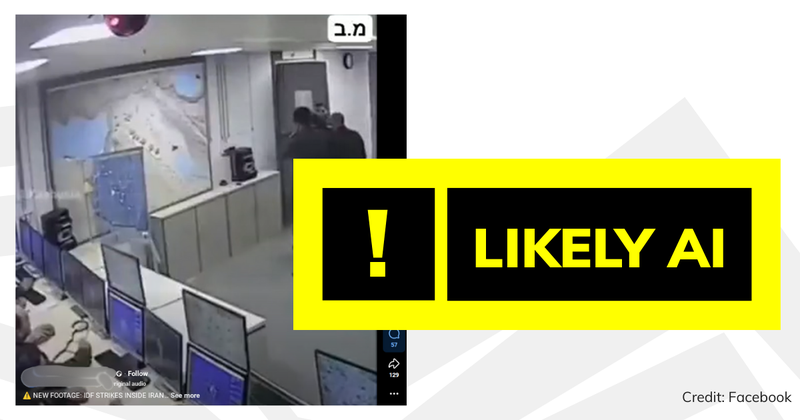
Many of the clips being shared on social media are quite grainy and blurry, making it difficult to identify signs of AI. But the earliest version Full Fact could find was posted on Instagram on 1 December in much higher definition, which made it easier to see mistakes and glitches common in AI-generated videos.
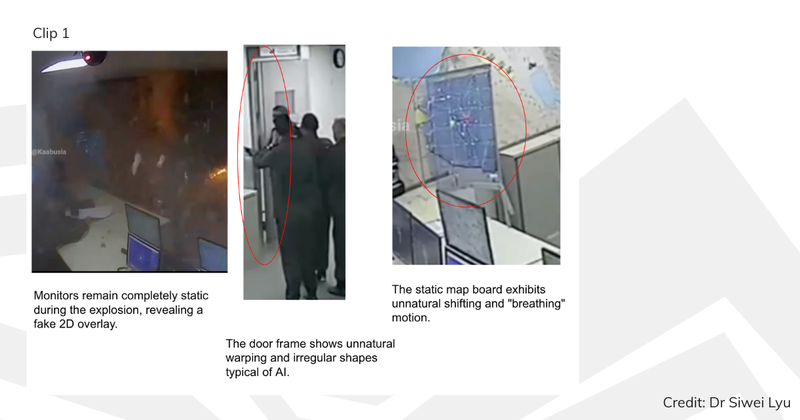
The first clip shows several monitors on the left of the screen and a group of people clustered near a door on the right. Within seconds there is a large explosion.
We consulted two experts about this: Dr Siwei Lyu, an expert in digital media forensics at University at Buffalo, State University of New York, and Professor Hany Farid, who specialises in digital forensics, misinformation and image analysis at the University of California, Berkeley, and is Chief Science Officer at GetReal Security, a cybersecurity company focused on preventing malicious threats from generative AI. They both told us they found evidence of AI-generation in this clip.
Dr Lyu highlighted the unnatural warping and irregular shapes of the doorframe as a clue the clip was made using AI, as well as the unnatural shifting and ‘breathing’ motion of the static map board. He also pointed out that the monitors remain completely static during the explosion, revealing a fake 2D overlay.
Professor Farid also described physical inconsistencies in the perspective geometry of the room interiors.
The second clip shows a man standing in military uniform in the middle of a room, with what looks like an Iranian flag on the left hand side. Again, within a few moments, there is an explosion.
Professor Farid said he also thought this clip was AI-generated based on a visual inspection. Dr Lyu agreed, noting that the digital clock displays “fluctuating, incoherent symbols instead of “stable, legitimate time data”. He also explained that the standing man “exhibits unnatural body warping and sudden hand displacement just before the explosion” and that the radar scanning line is “warped and crooked violating the straight line geometry of real displays”.
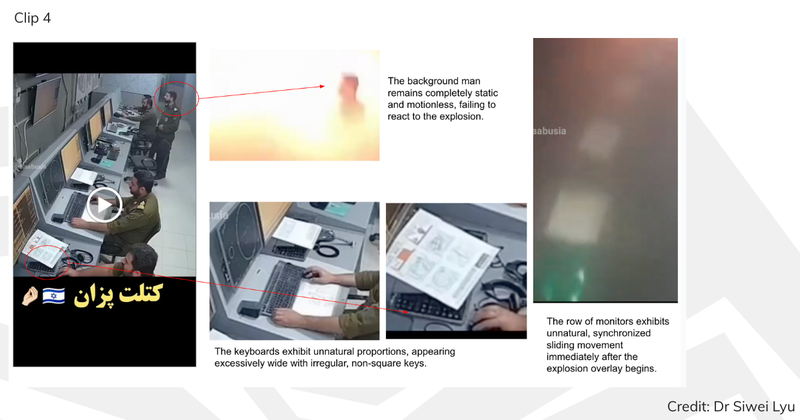
Both experts said there was evidence of AI-generation in the fourth clip too. It shows men looking at monitors before another explosion. Professor Farid again highlighted the perspective geometry, while Dr Lyu showed how the keyboards exhibited “unnatural proportions”, appearing “excessively wide”. A man in the video also fails to react to the explosion, remaining completely static and motionless. We also identified distorted-looking headphones on the desks, that appear to only have one earpiece each.
Join 73,000 newsletter subscribers who trust us to check the facts
Sign up to get weekly updates on politics, immigration, health and more.
Subscribe to weekly email newsletters from Full Fact for updates on politics, immigration, health and more. Our fact checks are free to read but not to produce, so you will also get occasional emails about fundraising and other ways you can help. You can unsubscribe at any time. For more information about how we use your data see our Privacy Policy.
Both experts agreed the third clip is probably real, however. It shows a uniformed man running across a room before an explosion. Professor Farid said he could find “no evidence of AI generation in the third clip” while Dr Lyu said the third clip “does not exhibit typical unnatural motion characteristics of AI-generated footage”.
This video was reportedly broadcast by Iranian state TV alongside other CCTV videos of Israeli attacks that took place in June this year. Unlike the suspected AI-generated videos, the CCTV camera goes dark after the blast in this clip.
We saw well over a dozen AI-generated or miscaptioned videos and images circulating widely on social media during the Israel-Iran conflict in June.
Misleading information can spread quickly during breaking news events, especially during periods of crisis and conflict.
Before sharing content that you see online, it’s important to consider whether it comes from a trustworthy and verifiable source.
If you’re wondering if a video clip is AI, one tip that’s worth noting is that some social media posts share versions of footage that are much more grainy and blurry than the original, making it difficult to identify signs of AI. So it’s always worth looking for clearer versions by searching key frames of footage using tools like TinEye or Google Lens.
We’ve created a toolkit with practical tips on how to identify bad information. We’ve also published detailed guides on how to spot misleading videos online and how a fact checker can tell if something is AI.
This article is part of our work fact checking potentially false pictures, videos and stories on Facebook. You can read more about this—and find out how to report Facebook content—here. For the purposes of that scheme, we’ve rated this claim as partly false because three of these clips are not real and were probably made with artificial intelligence, although one clip does appear to be genuine.
Full Fact fights for good, reliable information in the media, online, and in politics.
Bad information ruins lives. It promotes hate, damages people’s health, and hurts democracy. You deserve better.
Subscribe to weekly email newsletters from Full Fact for updates on politics, immigration, health and more. Our fact checks are free to read but not to produce, so you will also get occasional emails about fundraising and other ways you can help. You can unsubscribe at any time. For more information about how we use your data see our Privacy Policy.