AI-generated images of women in niqabs being turned away from Tesco stores circulate online

What was claimed
Images and videos show women in niqabs being turned away by security guards in Tesco stores.
Our verdict
False. These images and videos aren’t real and were made using artificial intelligence.
Images and videos being shared on social media with claims they show Tesco security guards stopping women wearing niqabs from entering stores are not real and were created using artificial intelligence (AI).
The posts, which have been liked thousands of times, typically feature an image of a security guard standing in what appears to be an aisle in a Tesco supermarket confronting a woman wearing a niqab. A caption under several versions of the post says: “Woman in niqab turned away by Tesco security - is this the right policy for UK stores?”
We couldn’t find any media reports of security guards at Tesco supermarkets turning away women for wearing niqabs.
While some political parties have committed to, or are reportedly considering, a ban on face coverings such as niqabs and burkas, the UK government has said it has no intention to introduce legislation to this effect. It said that under the Human Rights Act 1998 “everyone has the legal right to freedom of religion, including the right to express their religion” and “this includes the right to wear religious attire except where limitations are prescribed by law for specific limited purposes”.
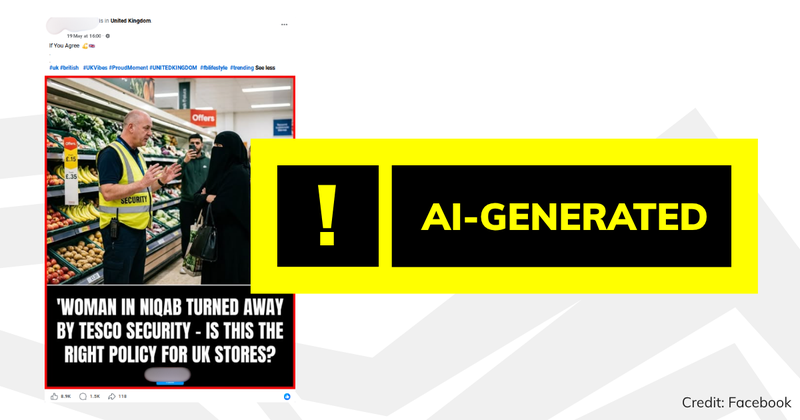
Many of the images being shared online contain garbled text errors which are typical of AI-generated content. Price tags are often unreadable, and some signs appear to be in a different language or include nonsensical phrases such as “2 for kg £2.50”.
A number of the videos and images also contain digital watermarks. One video contains a Google SynthID digital watermark, indicating it was generated or altered with one of Google’s AI products. Some images also contain Google SynthID digital watermarks, while others have a SynthID that shows they were made with OpenAI tools. Another post we’ve seen on X is labelled as “made with AI”.
Join 75,000 newsletter subscribers who trust us to check the facts
Sign up to get weekly updates on politics, immigration, health and more.
Subscribe to weekly email newsletters from Full Fact for updates on politics, immigration, health and more. Our fact checks are free to read but not to produce, so you will also get occasional emails about fundraising and other ways you can help. You can unsubscribe at any time. For more information about how we use your data see our Privacy Policy.
Before sharing content like this, first consider whether it comes from a verifiable and trustworthy source. Our guide to spotting AI content, and toolkit on how to identify bad information, can help you do this.
This article is part of our work fact checking potentially false pictures, videos and stories on Facebook. You can read more about this—and find out how to report Facebook content—here. For the purposes of that scheme, we’ve rated this claim as false because these images and videos aren’t real and were made using artificial intelligence.
Was this helpful?
Full Fact fights for good, reliable information in the media, online, and in politics.