Revealed: the Facebook pages using AI to flood feeds with bizarre fake stories about politicians saving kennels, cafes and babies
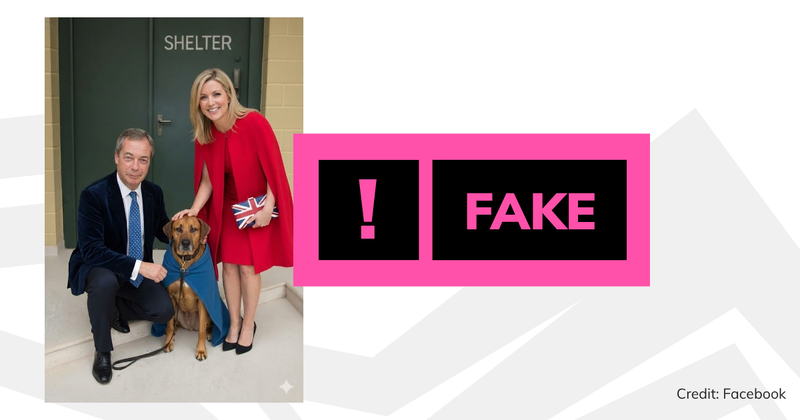
Looking directly into the camera, a suited Nigel Farage crouches on a step, his left hand gently holding a dog which, for some reason, is wearing a blue cape.
According to the caption shared with this viral picture on Facebook, the well-dressed canine is just one of 47 dogs rescued by the Reform UK leader and his partner Laure Ferrari after they bought a shelter which was struggling to pay its bills and on the verge of closure.
It’s a story with a happy ending according to the post, which accrued 40,000 ‘like’ and ‘love’ reactions: “The next morning, trucks arrived: new beds, medical care, food, toys. Above every kennel, a sign appeared: ‘Forever Home — Courtesy of Nigel Farage & Laure Ferrari’.”
There were over 4,000 comments, many of them from Facebook users who sounded hugely impressed. “Nigel this will increase your credibility on the political front,” wrote one. “Many people will vote for a person who shows compassion to animals.” Another said simply: “Lovely story, kind hearts.”
But this picture isn’t real, it’s AI—and the tale told in the caption seems to be a work of complete fiction.
It’s just one of a spate of bizarre fake stories about politicians which have flooded Facebook in recent months. And while false claims about politicians online are nothing new, what’s striking about this trend is that the posts all tell positive and sympathetic (albeit fictional) stories, often as emotional and heartwarming anecdotes.
Now a major Full Fact investigation has laid bare the scale of the problem—and prompted Facebook’s parent company Meta to remove some of the most prolific accounts.
We found that while many of the pages sharing this content had names mentioning the UK, such as ‘Britain Awakens’, ‘British Affairs Review’ and ‘Political Brief UK’, they were in fact mainly managed by profiles which appear to be based in Vietnam.
In total we recorded more than 380,000 reactions to over 100 of these Facebook posts, most of which used fake AI images alongside bogus stories.
Several of the 11 accounts we recorded publishing these kinds of posts remained active until March, when Meta was contacted by BBC Wales, which has also reported on the issue. Another page was subsequently deleted.
Six remaining accounts were removed by Meta this week after we contacted it. Meta told us: “We have clear community standards that prohibit harmful misinformation and inauthentic behaviour and we have removed these accounts for violating our policies.”
Join 75,000 newsletter subscribers who trust us to check the facts
Sign up to get weekly updates on politics, immigration, health and more.
Subscribe to weekly email newsletters from Full Fact for updates on politics, immigration, health and more. Our fact checks are free to read but not to produce, so you will also get occasional emails about fundraising and other ways you can help. You can unsubscribe at any time. For more information about how we use your data see our Privacy Policy.
AI-generated images and bogus bust-ups
The majority of the misleading posts we found focused on Nigel Farage, but we have also seen similar posts about other politicians, such as the Conservative former Prime Minister Rishi Sunak, Restore Britain leader and MP Rupert Lowe, and Reform’s home affairs spokesman Zia Yusuf.
The posts’ topics are often touching and philanthropic in nature—about Mr Farage donating millions to open homeless support centres across Kent, saving abandoned baby twins and giving up his first-class plane seat to a military veteran, or Mr Lowe saving a family-run Manchester cafe that supposedly fed him for free when he was an “unknown freelance writer”.
Some posts purport to be “heartfelt” updates about politicians recovering in hospital. Sometimes they’re about ”explosive” on-air bust-ups between politicians and Laura Kuenssberg or other TV presenters, with the politician invariably portrayed as the plucky underdog in the exchange.
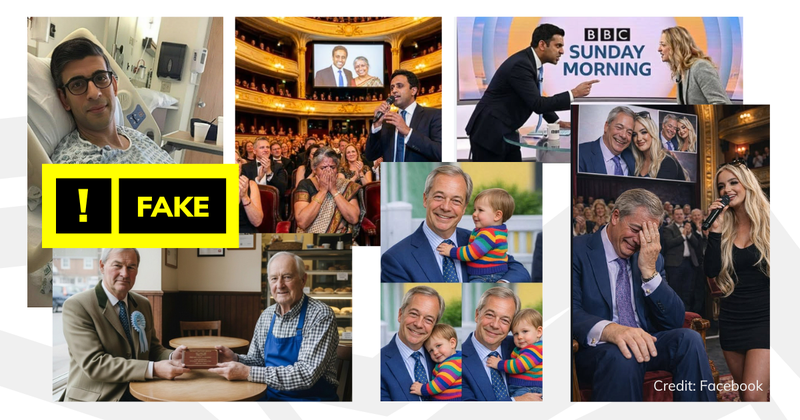
In February we fact checked posts which showed Mr Farage apparently by the bedside of a terminally ill child, with claims he was fulfilling their “final wish”. These posts used real photos of an American boy with leukaemia who sadly died last October. One real picture of him had been edited with AI to include Mr Farage.
Many users commenting on the posts correctly identify them as fakes, but we have seen plenty of interactions from people who appear to believe these are genuine feel-good stories.
How do we know these stories are fake?
Some of the pictures which accompany the posts, like the one of Mr Farage with a dog and an unknown woman (who doesn’t resemble his real partner), include the distinctive Gemini watermark, showing it was made with Google’s AI chatbot. Some contain the invisible SynthID watermark, which is included in content made with any of Google’s AI tools.
In other cases there are visual distortions which suggest they are AI-generated images, or the person pictured just doesn’t look much like the politician in real life. But many are convincing, and harder to identify as fakes.
Some posts are more obviously bogus for different reasons. Giveaways include posts supposedly about the UK mentioning “federal funding” or generous donations in dollars, or unlikely claims that hospitals have been built in the US by British politicians.
Others posts make claims about things which simply haven’t happened, and would almost certainly have been widely reported if they had—for example, the authorities being alerted about abandoned twins, Mr Farage being named as one of Time magazine’s “most influential people” or a trailer being released for a new Netflix biopic about a politician.
We’ve also checked directly with the subjects of the posts. Mr Sunak’s office told us in March that a post about him supposedly recovering from a medical procedure was “not factual”. A Reform UK spokesperson told us that as far as the party was aware, the claims about Mr Farage and Mr Zusuf were false, and stressed that Reform is not affiliated with any of the pages making the claims.
Who is creating these posts?
To be clear, there’s absolutely no evidence of any link between the pages publishing the fake stories and the politicians and parties featured in them. And in fact, there’s good reason to suspect the stories don’t originate in the UK at all.
Facebook’s ‘Page transparency’ feature records the location of the account or accounts which run a page. Some 10 of the 11 pages we found sharing fake stories were managed by at least one account based in Vietnam, sometimes alongside an account from another location such as the US or Hong Kong. (No location information was provided for the other page).
We’ve not been able to independently verify where those running the accounts are based, however, and when we’ve contacted them we’ve not had any response.
While we can’t be certain why the posts are being published, and at such scale, we found many of the pages were directing users in the comments away from Facebook to web pages which often featured longer versions of apparently fake stories, alongside adverts for products such as PDF readers. Some of these web pages mentioned Vietnam in their terms and conditions.
Meta also runs its own content monetisation programme, which allows Facebook pages to make money from their posts, subject to Facebook's Partner Monetisation and Content Monetisation policies. It’s unclear if any of the pages we looked at were part of this programme, however—Meta did not clarify this when asked.
When we checked Meta’s ad library we found that all of the pages we looked at had paid to run adverts on Facebook targeting people in the UK, apparently hoping to lead more people to engage with their content.
We found that pages had between them run more than 60 adverts, reaching an estimated 220,000 accounts (though this figure may count some accounts more than once if they saw multiple ads). The adverts we saw did not feature the fake stories directly—many instead used pictures of Nigel Farage alongside phrases such as “If you still stand by this man, press here”, inviting people to like and interact with their page.
‘Weaponising empathy’
Responding to our investigation, Sam Stockwell, senior research associate at the Centre for Emerging Technology and Security at the Alan Turing Institute, told us: “This particular campaign reveals a cynical shift: weaponising empathy rather than hate.
“Overseas content creators are now using AI to craft heartwarming fakes, knowing that social media algorithms prioritise content which trigger strong emotive reactions.”
And while we can’t know for sure whether the specific pages we identified monetised the engagement they generated, and if so how, both Mr Stockwell and Professor Martin Innes, co-director of Cardiff University's Crime and Security Research Institute, told us they were aware of content creators producing large numbers of fake posts in order to gain financially.
Professor Innes told us that he is seeing content creators now making use of the wider availability of AI technology and “churning out” misleading posts “at scale”, often generating revenue off the back of it.
“Where these kinds of visual disinformation and distortion used to take a reasonable amount of input, that is not the case anymore,” he said. “And as for the emotional register they are pitched in, that is just a way of trying to secure views in a noisy and cluttered attention order.”
Funding from Meta. Since January 2019, Full Fact has checked images, videos and articles on Facebook and other Meta platforms as part of the company’s Third-Party Fact Checking programme. This work is funded by Meta. The amount of money that Full Fact is entitled to depends on the amount of fact checking done under the programme. We are fully independent and Meta does not determine which checks Full Fact publishes or have any editorial control over our content.
Was this helpful?
Full Fact fights for good, reliable information in the media, online, and in politics.