Revealed: what the Scottish and Welsh election candidates talked about on social media
The economy dominated the conversation while national concerns like immigration and crime hardly featured, according to a Full Fact analysis of the social media posts from election candidates in Scotland and Wales.
To get a sense of what the candidates were talking about, Full Fact collected 33,294 posts that they published on Facebook and X between 15 April and 4 May. We then analysed—with the help of AI—the 19,126 posts representing the main parties in each nation.
This snapshot of their online activity reveals some things you might expect to find: it was posts from the Greens that were most likely to mention the environment in both countries; independence was a much bigger issue in Scotland than in Wales.
But we also found some things that might be less obvious: for example, in Scotland it was Reform UK candidates who talked about the environment more often than anyone apart from the Greens, while in Wales the Liberal Democrats were much more likely than other parties to talk about foreign affairs.
Join 75,000 newsletter subscribers who trust us to check the facts
Sign up to get weekly updates on politics, immigration, health and more.
Subscribe to weekly email newsletters from Full Fact for updates on politics, immigration, health and more. Our fact checks are free to read but not to produce, so you will also get occasional emails about fundraising and other ways you can help. You can unsubscribe at any time. For more information about how we use your data see our Privacy Policy.
The big picture
Data gathered by Democracy Club lists 685 different people who stood for election to the Scottish Parliament this year, and 675 for the Welsh Senedd.
Not all of them have X or Facebook accounts, however. And not all of those who do are regular users. Meanwhile, some are represented by the accounts of local parties who post on behalf of several candidates.
Our data therefore looks at a large sample of the candidates and parties who were active on these two social media platforms during the later part of the campaigning period.
One of the first things we noticed is that many social media posts just describe the candidates’ campaign activity—things like door-knocking and attending political events—without necessarily mentioning any areas of policy. Many more were reposts or replies where the topic wasn’t clear. Others posted about something too specific to belong in a wider category. Welsh candidates for both Labour and Plaid Cymru posted on Facebook about the importance of neutering cats, for example.
For about half the posts, therefore, the AI model we used didn’t attach any of the category labels we had defined. (You can see full details of the methodology we used below.)
We also noticed that although about 83% of the accounts we monitored represented the six main parties, some of the minor parties and independents were much more active on social media, making up 43% of all the posts we captured. Since some of these candidates posted about a small number of specific issues, we excluded them from the main analysis.
As you can see from the chart above, the economy, independence and health were the major policy topics in Scotland, as the economy and health were in Wales.
Education, transport and the environment were the next biggest topics in both countries, while there was strikingly little discussion of crime, immigration, foreign affairs and housing, on the whole. (A reminder that the devolved governments don’t have powers over some of the topics being debated nationally.)
How the parties differed
Once you discount the posts unrelated to our policy topics, the economy loomed large for candidates in all the main parties in both countries. In fact, no party talked more about any other subject, with the exception of the Lib Dems in Wales (health).
That aside, it’s striking how the SNP posted about independence much more than the other parties in Scotland, whereas Plaid Cymru actually posted about it less often than the Conservatives or Lib Dems in Wales.
Health and the environment (a category that includes posts about energy policy) were big topics for most parties in both countries. It is worth remembering here that our AI model only categorised what a post “is about” or “discusses”, which means a candidate could be expressing any opinion on the subject.
So whereas this Green post calls for a “fairer, greener and more equal future” in Scotland and this Reform post criticises renewable energy projects in Wales, both are posts about the environment.
Some specific areas of interest are what you might expect—like the Green focus on the environment, or the Reform focus on immigration. Others are less obvious. In Wales, the Lib Dems talked far more than the other parties about international matters, as did the Greens about housing.
In Scotland, transport seems to be a much more salient subject than it is in Wales, especially for the Lib Dems, SNP and Greens.
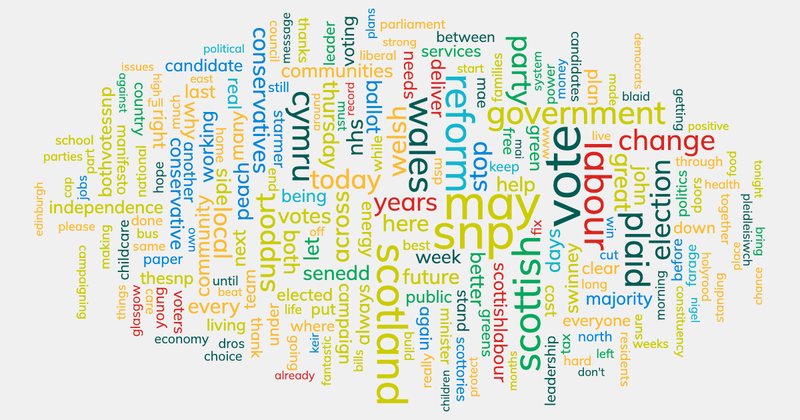
A collection of 19,126 social media posts by the six main parties is too large to summarise in general. Between them, they contain 873,648 words, which is the equivalent of about 11 books. But you can get a flavour, by looking at the most common words used by the main parties in Scotland and Wales.
How we did this
We began with the data listing all the candidates for election in Scotland and Wales, as published by Democracy Club. This includes crowdsourced details of their social media accounts, where known. Full Fact’s AI team then collected every post that these candidates published between 15 April and 4 May, inclusive. This includes reposts that the candidates shared, but didn’t write themselves.
Some candidates are represented by their party’s main account, if that’s how the Democracy Club data appears. But we only counted each post from each account once.
Next, we used AI to classify what the posts were talking about. This meant explaining the categories to a generative AI model, to which we fed a specific prompt, asking it to apply topic labels to each post in turn. It could add several when a post talked about more than one thing.
The process is not perfect. We cannot be sure that we captured all the posts from all the candidates in the first place, and a small number that we did capture were not classified for technical reasons, including because they contained an image or video but no text at all. (And the AI only had the text to classify.)
It’s worth remembering that some candidates are very active on social media, which means their posts may be very heavily represented within our analysis, especially within the figures for their party. And we only counted the number of posts mentioning topics, not how widely seen they were.
Classifying posts is a subjective process too, so the AI might not be correct every time, or it might make judgements that some people would disagree with. To check this, two fact checkers manually reviewed a random sample of posts, and the judgements we saw seemed reliable.
Was this helpful?
Full Fact fights for good, reliable information in the media, online, and in politics.