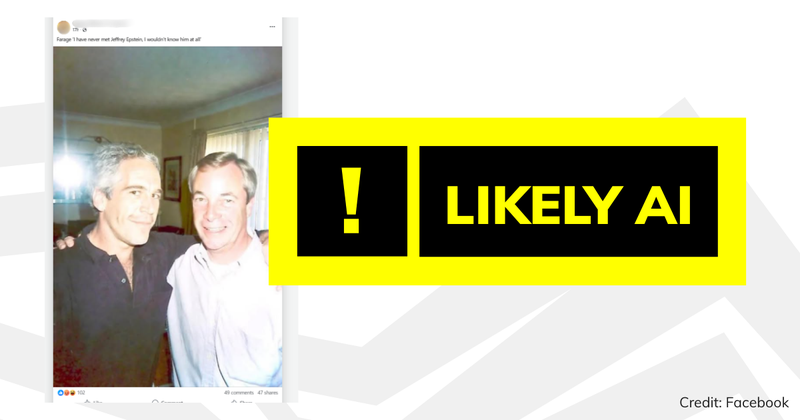
An image which appears to show convicted sex offender Jeffrey Epstein with his arm around the Reform UK leader Nigel Farage has gone viral in recent days. But there’s no evidence that it’s real, and experts have told Full Fact it was probably created with artificial intelligence.
The picture has been gaining thousands of shares and interactions on platforms including Facebook and X, after millions of files from the US government's investigation into Epstein were released on 30 January.
But a number of details in the image suggest that it isn’t real, and there’s no evidence that it has come from the latest Epstein files release, or any other credible source. Reform UK says the image is “completely fake”, and Mr Farage has denied ever meeting Epstein.
We’ve seen some claims that online AI detection tools have suggested the picture may be genuine. But in our experience these kinds of tools are not generally reliable, so we don’t use them in our fact checking of suspected AI content and don’t believe their verdicts on this image give us credible and reliable evidence that it’s real.
As we’ve written before, we and experts in AI imagery often end up having to caveat assessments of suspected AI images because it’s not always possible to prove beyond all possible doubt that a picture is fake—or if it is fake, whether it has been created with AI or edited in some other way. But all the clues we’ve seen point to this image having been created with AI.
What are the clues suggesting this image is fake?
A number of details in the image suggest it is not real.
Epstein’s ear in the image looks different compared to real pictures taken at similar angles. Like fingerprints, ears are unique to each person and the shape of the structure of the outer cartilage generally remains the same over time.
Additionally, in the viral picture both men are roughly equivalent in height, with their heads and shoulders more or less in line with each other. But in reality Epstein was 6ft tall, according to FBI documents, and Mr Farage is reportedly 5ft 8in tall. A real photo would most likely reflect this four inch (10cm) height difference.
At first glance the image appears realistic, without any very obvious glitches for example in the hands or body parts, which is something we warn people to look out for when trying to determine whether something is an AI creation. As AI becomes increasingly sophisticated these more clunky and obvious mistakes are becoming rarer.
Despite this, a closer investigation reveals several details which strongly suggest it was created with AI.
When we spoke to experts in the field of AI image and video analysis, they backed our findings and also identified other apparent inconsistencies.
What do the experts say?
Dr Siwei Lyu, an expert in digital media forensics at University at Buffalo, State University of New York, told us he had also concluded it is “unlikely” to be a real photograph.
He said the image included “artefacts inconsistent with perspective geometry, where parallel lines meet at the same vanishing points”.
He also highlighted other details including an “unnatural spill of the flash reflection beyond the mirror’s frame and the disjointed texture of [Epstein’s] eyebrows”.
The flash spill beyond the frame of the mirror appeared to be a “definitive optical inconsistency that exposes the image’s synthetic origin”, while Epstein’s eyebrows “lack natural hair-growth patterns”, he said.
Professor Hany Farid, who specialises in digital forensics, misinformation and image analysis at the University of California, Berkeley and is Chief Science Officer at digital verification company GetReal Security, pointed Full Fact to another issue with the image that he said “further supports the conclusion that the image is probably not authentic".
He said: “The size of the cast shadow that Farage’s body is casting on the object directly behind him is at odds with the size of the cast shadow his head is casting on the back wall. In particular, given the difference in distance of these surfaces relative to Farage, the shadow on the back wall is too small to be physically plausible.”
What has Nigel Farage said about Epstein?
When we asked Reform UK about the image, it told us that it is “completely fake”.
At a press conference on 3 February (at 22 minutes and 31 seconds in), Mr Farage said his name was mentioned “37 times in the files” but added: “I never met Epstein and I didn’t go to the island.”
A search of the Department of Justice files with Mr Farage’s full name returned 36 results, when we checked this week. But there’s no suggestion that being named in the files implies any wrongdoing. These references appear to mainly involve Mr Farage being mentioned in press articles shared by others.
None of the 36 mentions returned by the search relate to the image now circulating, and neither we nor other fact checkers have found any other evidence of the image being in the Epstein files.
Epstein died in his prison cell in August 2019 while being held on sex trafficking and conspiracy charges ahead of trial.
Before sharing content like this that you see on social media, first consider whether it comes from a verifiable and trustworthy source, and whether it could have been altered or created with AI tools. Our Full Fact toolkit can help you identify bad information circulating online.