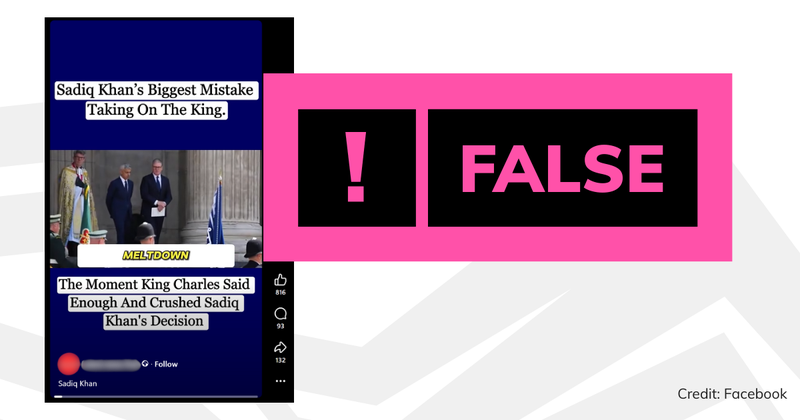
What was claimed
London is in meltdown after Sadiq Khan cancelled a royal event, the King’s garden bridge ceremony, over security concerns without informing King Charles.
Our verdict
This is false. No such event took place, and the ‘garden bridge ceremony’ doesn’t exist.
Videos viewed over 100,000 times on social media are falsely claiming that the Mayor of London cancelled a royal event without informing the King.
The clips, which have gained traction on Facebook, appear to be news reports about a major political incident, in which Sadiq Khan scrapped King Charles’s “garden bridge ceremony” over security concerns.
They claim that the monarch found out about the cancellation on Twitter, and Buckingham Palace responded by saying the event would go ahead as scheduled.
It claims sources within Buckingham Palace saw the King in a “controlled fury” and he invoked a “rarely used royal prerogative” allowing him to “seize public space for national ceremonies”.
The videos also claim that £1.7 billion was raised to support the event, and that pro-veteran protests “erupted outside City Hall” in response.
But none of these events have taken place, and the claims are completely false.
We can find no evidence that any such “garden bridge ceremony” was due to take place in London, or was scheduled for the King to appear at.
There had been plans to construct a pedestrian ‘Garden Bridge’ across the River Thames, but these were scrapped in 2017, and no part of the structure was ever built.
Additionally, there is no such royal prerogative which allows the monarch to seize public space for ceremonies, and we could not find any legitimate reports of pro-veteran protests occurring in response to the events described in the videos.
We have recently debunked other similar videos which make false claims about King Charles intervening in political events, or engaging in public disputes with politicians, often using likely AI-generated voiceovers.
Before sharing content like this on social media, first consider whether the source is credible and trustworthy. Our toolkit and guides to spotting bad information can help you do this.