What progress has Keir Starmer made on Labour’s ‘first steps for change’? Our Government Tracker’s verdict
On Monday 22 June, Sir Keir Starmer announced he will stand down as Labour party leader and Prime Minister.
It’s been nearly two years since Labour won the last general election.
Since November 2024, Full Fact’s Government Tracker has been monitoring Labour’s progress in delivering dozens of its manifesto commitments, as well as some key pledges made since.
Mr Starmer himself said in September 2024 that he wanted the government to have “clear, measurable targets” with “progress displayed publicly—so every single person in this country can judge our performance on actions, not words”.
Although Mr Starmer hasn’t handed over the keys to Number 10 just yet, following the announcement of his departure we’ve taken a look at the progress his government’s made delivering some of its key priorities.
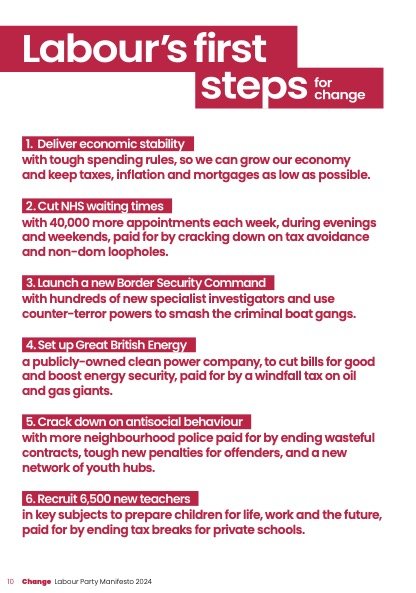
In total, our tracker’s now monitoring the delivery of 92 pledges. But we’ve looked here at 25 of the pledges which were among the most prominent in Labour’s 2024 election manifesto, because they were linked to its six “First steps for change”.
Please note - we keep the Government Tracker up to date on a rolling basis, and most of the pledges we’ve mentioned below have been updated recently. But if you’ve spotted something that needs updating, or doesn’t look quite right, please let us know.
Join 75,000 newsletter subscribers who trust us to check the facts
Sign up to get weekly updates on politics, immigration, health and more.
Subscribe to weekly email newsletters from Full Fact for updates on politics, immigration, health and more. Our fact checks are free to read but not to produce, so you will also get occasional emails about fundraising and other ways you can help. You can unsubscribe at any time. For more information about how we use your data see our Privacy Policy.
1. “Deliver economic stability”
Within this ‘step’, Labour said it wanted to “grow our economy”. One of Labour’s key manifesto commitments was to “kickstart economic growth to achieve the highest sustained growth in the G7”.
We’re still not entirely certain how “sustained growth” should be defined. But the government has said it is measuring this pledge using estimates of real GDP per head, rather than overall real GDP growth.
This means that, despite the UK having the highest GDP growth rate in the G7 in the first quarter of this year, using the government’s own metric we’re currently rating this pledge as appears off track. That’s because the latest comparable figures (for Q4 2025) show the UK did not have the highest GDP per head growth rate.
As part of this step, Labour mentioned it wanted to “keep taxes [...] as low as possible.” Elsewhere in its manifesto it promised: “Labour will not increase taxes on working people, which is why we will not increase National Insurance, the basic, higher, or additional rates of Income Tax, or VAT.”
In its first Budget, Labour made the controversial decision to increase employer’s National Insurance contributions, and in its 2025 Budget it extended the freeze on the thresholds of both income tax and National Insurance, which means that from April 2028 people will pay more in these taxes than they otherwise would have done.
As a result, we’ve rated the pledge to “not increase taxes on working people” and the pledge to “not increase National Insurance” as not kept, while we’ve rated the Income tax pledge as unclear or disputed (the wording of this pledge specifically referred to the headline rates which have not been changed, but the chancellor has previously appeared to suggest extending the income tax threshold freeze could breach the manifesto).
Coming to a verdict on these pledges was complicated though, so for a detailed explanation of our logic see each of the pledge pages.
As no increases have so far been announced, we’re rating the promise to not increase VAT as appears on track.
Another key pledge we’ve looked at related to the “tough spending rules” mentioned in the first of Labour’s first steps for change—elsewhere in the manifesto Labour said: “Our fiscal rules are non-negotiable… This means that the current budget must move into balance, so that day-to-day costs are met by revenues and debt must be falling as a share of the economy by the fifth year of the forecast”. We’re currently rating this as appears on track, though the Office for Budget Responsibility has warned economic uncertainties could challenge this in the future.
2. “Cut NHS waiting times”
The second of Labour’s first steps clearly promised to provide “40,000 more appointments each week” in order to help cut NHS waiting times.
This specific commitment has been achieved. The pledge to provide 40,000 more NHS appointments in England per week—or an extra two million over the year—was surpassed between July 2024 and June 2025, with 5.2 million more appointments than the year before.
However, that increase is actually less than the rise seen between July 2023 and June 2024, so as our tracker explains, there’s a question over how meaningful the pledge really was to begin with. An increase of just two million appointments a year would have been the smallest annual rise since the pandemic.
Two financial pledges which appear to be mentioned in this step, to “[crack] down on tax avoidance and non-dom loopholes”, have also been achieved.
But we’re rating another manifesto pledge related to the NHS, to “double the number of CT and MRI scanners”, as appears off track.
In total our Government Tracker is currently rating progress on 11 health pledges.
3. “Launch a new Border Security Command”
We’re rating the headline pledge of Labour’s third first step as achieved, as the Home Office has created a Border Security Command, with a commander appointed and funding allocated.
The step also refers to small boat crossings, which are still occurring. Labour has made progress on some of the migration promises included in its manifesto, such as ending the Migration and Economic partnership with Rwanda and negotiating additional returns agreements, which have both been achieved.
The promise to “end asylum hotels” we’re currently rating as in progress, as the latest data shows that as of March 2026 the number of asylum seekers housed in hotels was 29% lower than in June 2024, while the number of asylum hotels has also decreased.
We’re rating the pledge to “set up a new returns and enforcement unit, with an additional 1,000 staff” as not kept, however. This is because, while 1,000 full-time equivalent Home Office staff have been redeployed to work on returns and enforcement activities, a Freedom of Information request submitted by Full Fact revealed the government has now decided not to set up a separate unit for this purpose.
It’s also worth noting that Labour’s promise to “reduce net migration” appears on track.
4. “Set up Great British Energy”
Labour’s promise to set up GBE and make it a “publicly-owned clean power company” has been achieved, though we’re currently rating the commitment to capitalise it with £8.3 billion as in progress. These funds have been allocated jointly to GBE and Great British Energy - Nuclear, a separate government-owned company, over the course of the Parliament. However, year-by-year funding doesn’t seem to have been announced yet.
5. “Crack down on antisocial behaviour”
While this step simply refers to “more neighbourhood police”, later in the manifesto as well as in its December 2025 Plan for Change and its Neighbourhood Policing Guarantee, Labour said it wanted “13,000 additional” police officers, PCSOs and special constables. We’re rating this commitment as appears on track.
It’s not entirely clear what the “tough new penalties for offenders” in this step refer to. However, we’re rating as appears on track Labour’s promises to “scrap the effective immunity for some shoplifting” and to “create a new specific offence for assaults on shopworkers”.
We’re rating two key manifesto commitments, to raise confidence in both the police and the criminal justice system to its highest levels, as wait and see and unclear or disputed respectively, as we don’t have sufficient data yet for the former and Labour still hasn’t outlined how it’ll measure progress against the latter.
6. “Recruit 6,500 new teachers”
We’re rating the headline pledge of this final step, to “recruit 6,500 teachers in key subjects”, as appears on track, though performance against this pledge, and how it should be measured, has been contested recently.
The latest figures show there’s been an increase of 3,007 secondary and special school teachers, and 1,646 further education teachers, since 2023/24, which Labour has said it is taking as its baseline. It’s worth noting though that the overall number of teachers has fallen.
This step says Labour will pay for the new teachers “by ending tax breaks for private schools”. While VAT is non-hypothecated, meaning its receipts go into the Treasury’s Consolidated Fund rather than directly towards any policy, we’re rating the promise to “end the VAT exemption and business rates relief for private schools” as achieved.
While these are some of the most prominent manifesto pledges which we’re monitoring, for a full rundown of our latest assessments of all 92 pledges, see our Government Tracker.
Update 27 July 2026
We’ve updated this article to reflect that we’re rating Labour’s pledges to “create a new specific offence for assaults on shopworkers” and to “scrap the effective immunity for some shoplifting” as ‘appears on track’.