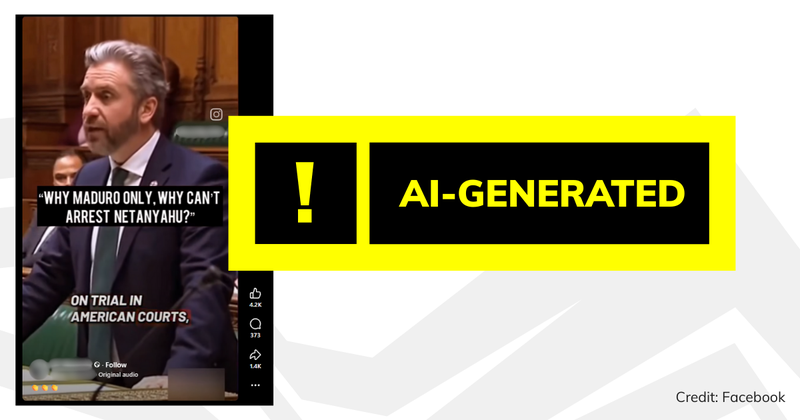
A video which appears to show an MP asking Parliament why Israel’s Prime Minister cannot be captured and brought to court in a similar manner to the Venezuelan leader Nicolás Maduro is not real—it was created with AI.
The clip, which has been shared widely and had millions of views across social media platforms, seems to show a question in the House of Commons from a male MP standing at the despatch box.
He says: “If the United States can conduct an operation in Venezuela to capture Nicolás Maduro, an elected president, and put him on trial in American courts, then why is it impossible to capture Benjamin Netanyahu from Israel and bring him before international court?”
The video also includes apparent shots of seated MPs on the Commons chamber’s green benches, and a man wearing a chain seemingly sitting in the speaker’s chair.
It has been circulating after Venezuelan leader Mr Maduro was seized along with his wife Cilia Flores in an overnight raid by US forces on 3 January. They have appeared in court in New York and pleaded not guilty to various drugs and weapons charges brought by the US government.
But the man shown speaking in the viral video is not a real MP. His face does not match genuine images of current serving MPs in the House of Commons.
Others shown in the video, including the person sitting in the speaker’s chair, also appear to be AI creations. The speaker of the House of Commons is currently Sir Lindsay Hoyle MP, who looks nothing like the man pictured in his seat in the video, while all three real deputy speakers are women.
There was a discussion in the Commons Chamber about the arrest of President Maduro on 5 January, but we’ve not been able to find anything in the transcript resembling the comments made in the video.
The earliest version of the video being shared we’ve been able to find is a TikTok video published on 5 January, which has been viewed 5.4 million times.
This version includes a watermark from Sora, an AI text-to-video generator developed by OpenAI.
The watermark, which moves around the frame, has been blurred out in other versions being shared elsewhere.
The bio of the TikTok account says: “I am just turning my thoughts into videos. Most of the content is AI generated and only for awareness and knowledge.” The account has also shared a number of other videos of fake political moments featuring the Sora watermark, including one which appears to be of the Scottish Parliament.
During unfolding global events, misinformation and misleading content can spread quickly online. Before sharing videos such as these, first consider whether they come from a verifiable and trustworthy source. Our guide to spotting AI content, and toolkit on how to identify bad information, can help you do this.