Japan hasn’t named Covid mRNA vaccine the ‘most deadly drug’

What was claimed
Japan has named a Covid mRNA vaccine the most deadly drug in the history of humankind.
Our verdict
False. Japan has done no such thing. Approved mRNA Covid-19 vaccines are considered safe.
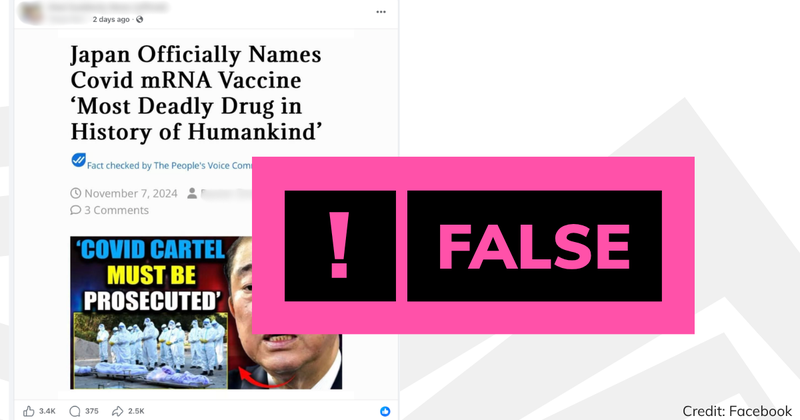
Posts shared thousands of times on social media have repeated a long-standing false claim that Japan named the “Covid mRNA vaccine” the “most deadly drug in [the] history of humankind”.
Japan has done no such thing. Approved mRNA Covid-19 vaccines are considered safe and are used around the world.
The posts include a screenshot of an article that appeared on a website called The People’s Voice in November 2024, which we’ve fact checked various claims from before.
The claim has been circulating since at least 2024 and has been debunked by other organisations. Full Fact has previously checked false claims that Japan had banned mRNA Covid vaccines.
Officials at the Japan-Taiwan Exchange Association told fact checkers at Asia Fact Check Lab in November 2024 that “Japan’s government has not issued any such announcement”. We’ve not found any credible news reports that such an announcement has been made since then. And when we asked the Japanese Embassy in the UK about the claim, it directed us to a statement by the country’s Ministry of Health, Labour and Welfare which says the vaccine is safe.
The People’s Voice article includes a video which covers a press conference held by a Japanese politician in September 2024, in which he expressed concerns over the safety of the Kostaive messenger RNA (mRNA) vaccine. But this politician did not say the vaccine was the “most deadly drug in [the] history of humankind” either.
Kostaive has since been approved for use by the European Medicines Agency and the UK’s Medicines and Healthcare products Regulatory Agency (MHRA).
Join 75,000 newsletter subscribers who trust us to check the facts
Sign up to get weekly updates on politics, immigration, health and more.
Subscribe to weekly email newsletters from Full Fact for updates on politics, immigration, health and more. Our fact checks are free to read but not to produce, so you will also get occasional emails about fundraising and other ways you can help. You can unsubscribe at any time. For more information about how we use your data see our Privacy Policy.
What are mRNA vaccines?
As we’ve explained before, the mRNA in vaccines carries messages that the body interprets to make proteins so it can mount an immune response. The mRNA is then naturally broken down after a few days. It has been studied for decades, even though it only gained worldwide attention during the Covid-19 pandemic.
Unlike traditional vaccines, mRNA vaccines can be designed rapidly, and there have been trials to see how the technology might be used to target other conditions, such as cancer and infectious diseases like influenza.
We’ve written extensively about false and misleading claims we’ve seen about mRNA vaccines, as well as vaccines and Covid-19 more broadly.
False or misleading information about health can cause serious harm, either immediately or in the longer term. It can damage people’s physical or psychological health, and put particular communities at risk. Health misinformation that spreads at scale can introduce confusion about the causes and treatments of illnesses, create distrust of medical professionals, and undermine medical consensus and public health messaging.
This article is part of our work fact checking potentially false pictures, videos and stories on Facebook. You can read more about this—and find out how to report Facebook content—here. For the purposes of that scheme, we’ve rated this claim as false because Japan has not said Covid mRNA vaccines are the most deadly drug in the history of humankind.
Was this helpful?
Full Fact fights for good, reliable information in the media, online, and in politics.