Fake photo of damaged US base in Kuwait shared online

What was claimed
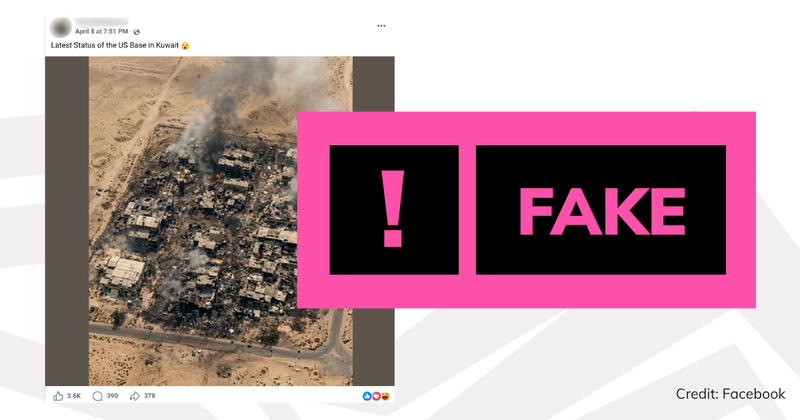
An image shows a destroyed US base in Kuwait.
Our verdict
This image is fake. It doesn’t correspond to genuine satellite imagery of US military bases in Kuwait, and contains a SynthID watermark, indicating it was generated using Google's AI tools.
A widely shared image that appears to show a destroyed US base in Kuwait is fake.
The image, shared on Facebook, Instagram and Threads on 8 and 9 April, appears to have been taken from the air, and shows a cluster of buildings in a desert which are severely damaged, with visible flames and smoke plumes rising from them.
It has been captioned: “Latest Status of the US Base in Kuwait.”
US outlet CBS News reported on 6 April that 15 Americans were injured in an overnight Iranian attack on Ali Al Salem Air Base, which also hosts the US military.
However, the picture being shared on social media doesn’t show the aftermath of this attack.
Join 75,000 newsletter subscribers who trust us to check the facts
Sign up to get weekly updates on politics, immigration, health and more.
Subscribe to weekly email newsletters from Full Fact for updates on politics, immigration, health and more. Our fact checks are free to read but not to produce, so you will also get occasional emails about fundraising and other ways you can help. You can unsubscribe at any time. For more information about how we use your data see our Privacy Policy.
Genuine satellite images of the base show it is far larger than what’s shown in the viral image, and we couldn’t find a match for the configuration of buildings it depicts.
We also checked satellite views of other US military installation bases in Kuwait—including Ahmad al-Jaber Air Base, Camp Arifjan and Camp Buehring—and couldn’t find any that corresponded to the collection of buildings shown in the picture. Some of these bases in Kuwait have reportedly been struck many times.
A drone attack on 1 March on a tactical operations centre at the Shuaiba port in Kuwait killed six US service personnel, and wounded more than 20 others. But again, the picture being shared doesn’t correspond to this location.
Reverse image searches also did not show this image being used in any legitimate reports of real attacks on US bases in Kuwait.
And we found the viral image contained a SynthID watermark, an invisible watermark added to content created or edited with Google’s AI tools.
While the presence of a watermark can't tell us whether AI was used to completely generate a brand-new image or modify an existing one, the fact that the layout of the base is inconsistent with the real map images suggests it was wholly generated with AI.
We have fact checked other examples of fake and AI-generated content claiming to be from the ongoing conflict in the Middle East, as well as miscaptioned videos from other places and points in time circulating online.
Before sharing content like this that you see on social media, it’s important to consider whether it could have been altered, faked or manipulated with AI. Our Full Fact toolkit contains guides on how to spot suspected AI content.
This article is part of our work fact checking potentially false pictures, videos and stories on Facebook. You can read more about this—and find out how to report Facebook content—here. For the purposes of that scheme, we’ve rated this claim as altered because this isn’t a genuine image. It doesn’t match the layout of US military bases in Kuwait, and has an AI watermark.
Was this helpful?
Full Fact fights for good, reliable information in the media, online, and in politics.